Most Kuwait web agencies will tell you they "do Arabic." Fewer of them actually do right-to-left design. The gap between those two things is where most bilingual website projects go wrong: you end up with a site that has Arabic words on it, laid out exactly like the English version, with navigation on the wrong side and forms that read backward.
Here's what bilingual actually means beyond translation, how a proper Arabic/English site should be structured, the signs an agency is only paying lip service to it, and what it should cost and take in Kuwait.
What "bilingual" actually means for a Kuwait website
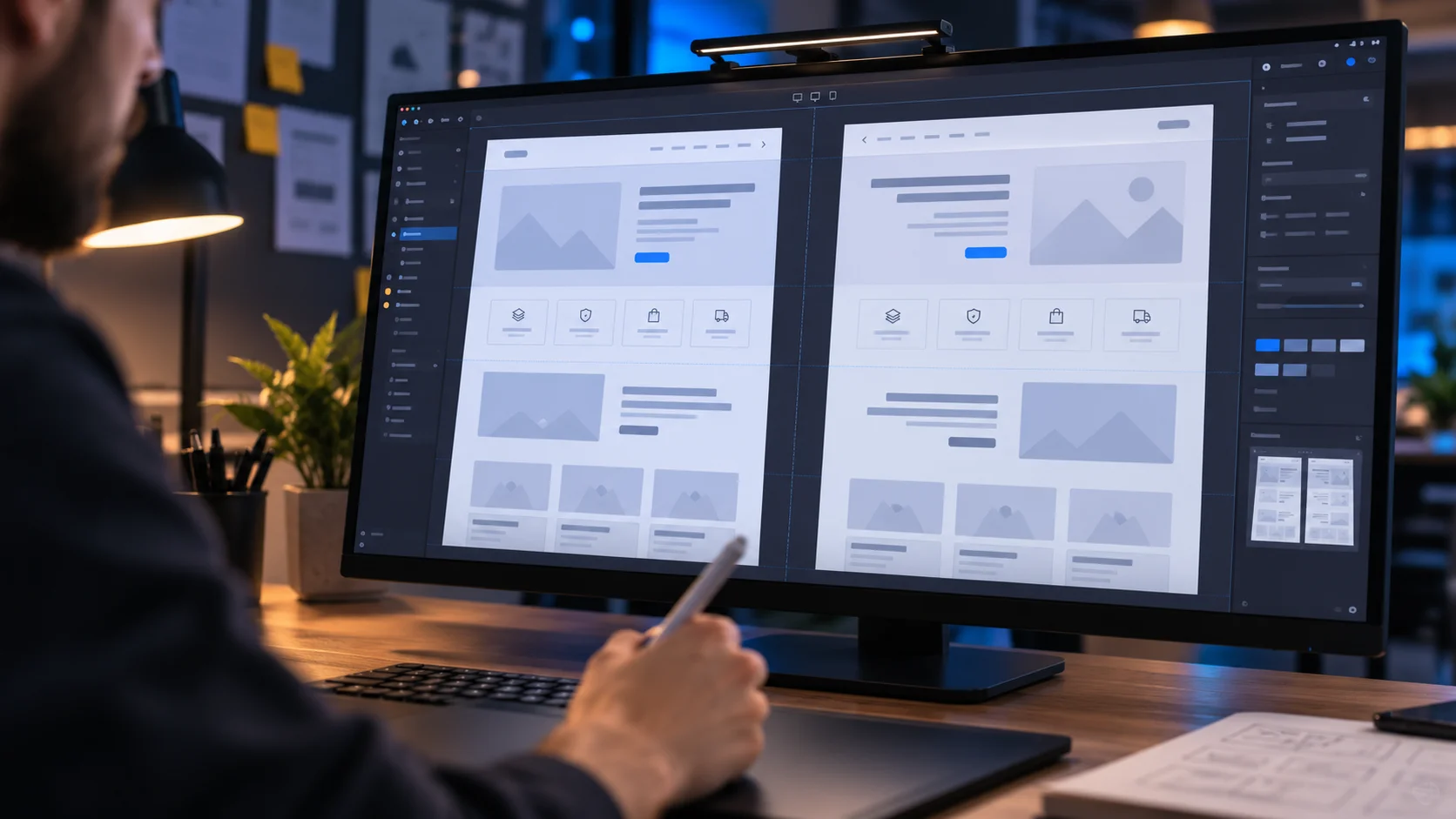
A translated site swaps the words. A bilingual site rebuilds the layout logic for Arabic, because right-to-left isn't a text setting, it's a design decision that touches almost everything on the page:
- Navigation and layout. The logo and main navigation move from the top left to the top right. Directional icons and arrows flip (a forward arrow becomes "←"), but neutral icons like a download or trash icon stay as they are.
- Forms. Labels and headings shift from top-left to top-right alignment, not just right-aligned text bolted onto a left-to-right form structure.
- Typography. Arabic needs fonts built to render Arabic characters properly, like Google Noto, or you get "tofu": blank boxes where characters should be. Underlined Arabic hyperlinks are a common mistake too, since the underline obscures the dots and diacritical marks that carry meaning in Arabic script.
- Cultural content. Imagery that reads fine in English can land badly in Arabic, and small details like Eastern versus Western Arabic numerals matter depending on the audience.
None of this is exotic. It's documented, well-understood design practice. The problem is that it takes real work to do properly, and a lot of agencies skip straight to running your copy through a translation tool and calling it done.
How Arabic and English should be structured, not just translated
The technical structure matters as much as the visual design, and it's where cutting corners shows up in search rankings months later.
URL structure. Arabic and English content should live at separate, crawlable URLs, ideally path prefixes like yoursite.com/en/ and yoursite.com/ar/. Cookies, IP-based redirects, or a single shared URL with a language switcher all make it harder for Google to index both versions correctly and for you to track them separately in analytics.
hreflang tags. These tell search engines which page is the Arabic version of which English page, and it has to work both directions: the English page needs to reference its Arabic counterpart, and the Arabic page needs to reference the English one back. One-directional hreflang, where only one language points to the other, is one of the most common mistakes in bilingual sites and it quietly breaks how search engines understand the site.
Content model. If the CMS doesn't support real field-level bilingual content (separate Arabic and English fields on the same page, not two duplicated pages maintained by hand), every future content update becomes a manual, error-prone chore. This is worth asking about before the site is built, not after.
Keywords, not just translated copy. Arabic search behavior isn't a literal translation of English search terms. Copy that's translated word-for-word from English keyword research tends to read awkwardly and rank for almost nothing, because it doesn't match how people actually search in Arabic.
Signs an agency is only paying lip service to Arabic
A few tells show up consistently:
- Their bilingual quote is the same price as an English-only site. RTL layout, typography, and QA are real additional work, so a matching price usually means that work isn't happening.
- Their portfolio's "Arabic" examples are screenshots, not live sites you can open and test on your own phone.
- They describe their Arabic process as translation plus a quick native-speaker read-through, with no mention of layout mirroring, RTL-specific typography, or dedicated QA.
- They can't explain how they'll structure the URLs or whether they'll implement hreflang when you ask directly.
- The demo site they show you has left-aligned Arabic text sitting inside an otherwise untouched English template.
What to check in their portfolio and process
Before you commit, ask to see and verify a few concrete things rather than taking their word for it:
- A live bilingual site they built, not a case study slide. Open it on your own phone and switch between languages.
- Who writes the Arabic copy. A professional Arabic copywriter or translator produces different results than a staff member doing it as a side task.
- What the CMS looks like on the Arabic side. Ask them to show you how they'd add a new bilingual page, and whether that means editing one page with two language fields or maintaining two separate pages by hand forever.
- Who does QA, and whether a native Arabic speaker actually reviews the site before launch, across more than one browser and on mobile.
Cost and timeline for a proper bilingual build
Kuwait web development pricing for English-only sites runs roughly like this in 2026: a basic informational site around 300 to 800 KWD, a corporate business site 300 to 3,500 KWD, an ecommerce store with KNET integration 1,500 to 4,000+ KWD, and a custom web platform or portal 5,000 to 20,000 KWD. These are broad market ranges, not a quote, and complexity moves the number a lot within each tier.
A proper bilingual build costs more on top of whichever tier you're in, and that's expected, not a red flag by itself. Right-to-left layout, typography, and QA are genuine extra design and development work, not a checkbox. Kuwait is notably one of the only Gulf markets where agencies openly price Arabic work as a separate line item rather than folding it in quietly (and often skipping it). Treat a quote that doesn't call this out separately with suspicion.
On timeline, a template-based English site can take a matter of days and a custom WordPress build around two weeks, but add real time for RTL layout work and native-speaker QA on top of that if the site is genuinely bilingual. A rushed bilingual timeline is usually a sign the RTL pass is getting skipped.
Questions to ask before you sign
- Is bilingual work priced as a separate line item, and what specifically does it cover: translation, RTL layout, or both?
- Who writes the Arabic copy, and is it reviewed by a native speaker before launch?
- Can I see a live site you built, not a screenshot, and test it myself?
- What's the URL structure for the two languages, and will hreflang be implemented both directions?
- Does the CMS support real bilingual content fields, or will I be maintaining duplicate pages by hand?
- Who does QA, and across which browsers and devices?
Related reading: Dsrpt's think-tank has more on what a website actually costs and what matters, how long a website takes to build in Kuwait, and how to choose a digital marketing agency in Kuwait, most of which applies just as well when you're picking a bilingual web partner.
Where this leaves you
Ask to see a live Arabic page before you sign anything, not a screenshot in a pitch deck. Open it on your own phone, check whether the layout actually mirrors, whether the fonts render cleanly, and whether the URL structure looks like /ar/ and /en/ rather than a language switcher bolted onto one template. If an agency can't show you that, or the bilingual quote matches the English-only one, that's your answer before you spend a single dinar.