

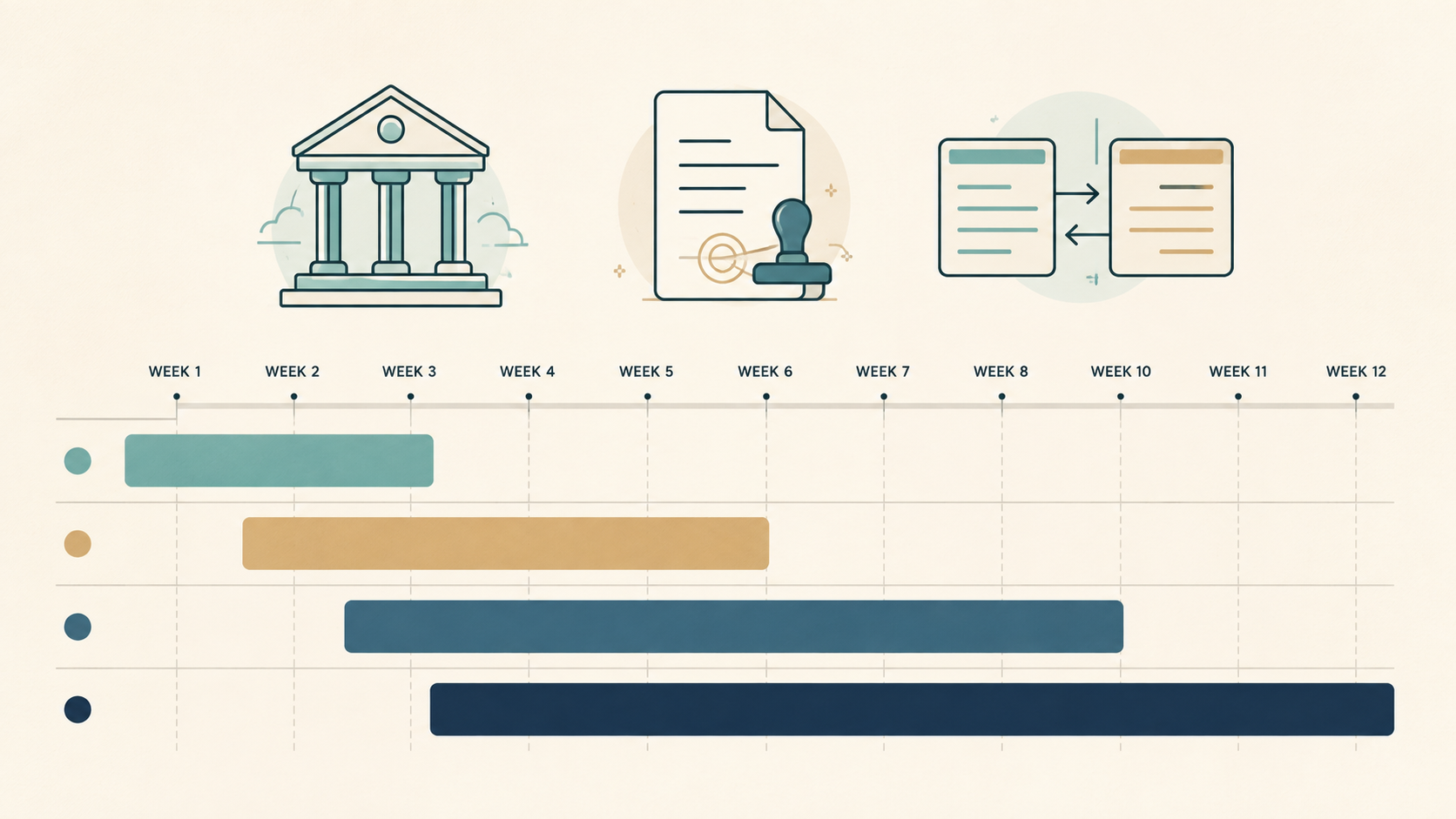
A brochure site takes 2 to 4 weeks. A CMS site your team updates itself takes 4 to 8. An ecommerce store with KNET takes 8 to 14. A custom platform starts at 3 months and goes up from there. Those are build weeks, and almost nobody hits the low end, because the delay is rarely the code.
Here is where the time actually goes, what makes a Kuwait project different from the same project in Sydney, and how to tell a genuinely fast agency from one guessing at a number to win your deal.
The ranges, by project type
| Project type | Realistic range | Fast end looks like | Slow end looks like |
|---|---|---|---|
| Brochure site, 5 to 8 pages | 2 to 4 weeks | Template, your content ready on day one, one approver | Custom design, content written during the build, three approvers |
| CMS site your team edits | 4 to 8 weeks | Off-the-shelf CMS, standard page types | Custom content model, migration from an old site, staff training |
| Ecommerce store with KNET | 8 to 14 weeks | Under 50 products, one bank already onboard, one language | Hundreds of variants, a new KNET application, Arabic and English |
| Booking or portal build | 10 to 16 weeks | Existing system to copy, clear rules | Rules that get discovered during the build |
| Custom platform | 3 months and up | Written spec signed before anyone opens an editor | "We'll figure out phase two later" |
Design and development are the predictable half. The other half is approvals, content, and third parties who do not work to your schedule. The build hours in an estimate are usually close to right. The launch date is what moves, and it moves in weeks.
If you want the cost side of the same question, we broke that down separately in what website development involves and what it costs.
The four things that add weeks in Kuwait specifically
KNET is a bank decision, not a developer task
This is the single most misunderstood item on any Kuwait ecommerce timeline. KNET's own page says it plainly: you contact a local member bank and sign a contract to join the service, and only after the bank sends the request does KNET contact you with the API and documentation.
The note underneath is blunt: KNET does not provide services directly to any merchant or customer. So the sequence is bank first, integration second. Your developer cannot start until your bank finishes, and the bank's speed depends on your commercial registration, your sector licence if your activity needs one, and how quickly you return their paperwork.
What to do about it: start the bank conversation the same week you sign with your agency, not the week before launch. A team that has done this before will ask you for your CR number in the kickoff call. If nobody asks, that timeline is a guess.
The 2026 digital commerce law is about to add scope to every ecommerce build
Decree-Law No. 10 of 2026 was published in the Kuwait Official Gazette on 1 March 2026. Start with the timing, because it is the part most write-ups get wrong: the law is not in force yet. Article 44 gives the Minister a year from publication to issue the implementing regulations, and Article 45 sets the effective date one month after those regulations appear. So the deadline sits somewhere after March 2027 and nobody can name it precisely.
Build to it anyway. Retrofitting an Arabic invoice engine into a live store costs more than including it. Here are the parts that turn into build work:
- Article 10: your name or trade name, registration number and full contact details displayed prominently on the platform.
- Article 11: contract terms covering the product description, the final price including delivery, accepted payment methods, delivery timelines, offer validity periods, and the return and exchange policy.
- Article 12: an electronic invoice issued in Arabic once a transaction completes, carrying price, fees, total, delivery date and location, and payment method. Other languages can be added, Arabic cannot be dropped.
- Article 13: a complaints mechanism, with records kept at least six months.
- Article 17: a 14-day withdrawal window from receipt, with a full refund to the original payment method or another method you both agree, provided the product comes back in its original condition at no extra cost to the customer. Precious metals get 24 hours instead, and a category of high-value items that a later ministerial decision still has to define.
- Article 28: you may only engage payment service providers licensed by the Central Bank of Kuwait, and your payment options have to be simple and non-discriminatory.
None of that is hard. All of it is scope, and scope written down after the design is signed is what turns an 8 week build into 12. The platform you pick decides how much of it you get for free, which we covered in choosing an ecommerce platform for the GCC.
Arabic and English is not a translation job
Founders budget for translation. The cost is the layout.
An Arabic site runs right to left, which means the whole interface mirrors. Navigation, breadcrumbs, form labels, icons with direction in them, progress bars, card layouts, table column order. Numbers and Latin brand names stay left to right inside a right to left paragraph, so every mixed sentence is a place where text can render in the wrong order. Arabic type also needs its own line height and its own fonts to look right at small sizes, and the same sentence takes a different amount of room in each language, so buttons and headings that fit in one break in the other.
Then there is the part nobody plans for: every piece of content now exists twice, and the second version has to be approved by someone who reads Arabic properly. That approval loop is what actually costs the weeks.
Rule of thumb we use: a genuinely bilingual site adds 30 to 40 percent to design and front-end time, and roughly doubles the content calendar.
Content is the reason projects run late
If a project slips, this is usually why. Photography that was never booked. Product descriptions for 180 items that one person is writing in the evenings. Team bios waiting on the one director who is travelling. A legal page that has to go past a lawyer.
Design and build can run in parallel with content only up to a point. Past that point the project sits still, and it sits still at your end, which is the part clients find hardest to hear.
The fix is boring and it works: agree the content list in week one, name one owner per item with a date, and treat a missing item as a blocker rather than something to catch up on later.
What "fastest turnaround" actually costs
Fast is real. It is just paid for somewhere, and it is worth knowing where before you buy it.
A two week website means a template rather than a custom design, a fixed page count, your content ready before the kickoff call, one decision maker with authority to approve, and no third-party integration waiting on someone else's approval queue. Take those away and the same team cannot do it in two weeks either.
The version to avoid is the one where speed is bought by skipping the things that do not show up in a demo. Page speed. Structured data. Analytics that actually tracks a lead. Proper heading structure and metadata. A site can look finished and still be invisible, and fixing that later costs more than doing it during the build, which is the argument behind most of our SEO work.
Add one more to that list in 2026: whether an AI assistant can read and cite your site at all. If your pages render only in JavaScript, or your key facts live in images, most assistants see nothing. That is the whole point of AI search optimisation, and we covered the mechanics in how to rank on ChatGPT, Gemini and Perplexity.
How to tell a real timeline from a sales number
Ask for the last three projects the agency delivered, by name, with two dates each: the date the contract was signed, and the date the site went live.
An agency that tracks its own delivery will have those in a minute. One that does not will offer you an average instead. That answer, on its own, tells you most of what you need.
Three follow-ups worth asking:
- What did you wait on in each of those three, and how long did the waiting take?
- Which of my items, if it arrives late, moves the launch date?
- Is this estimate build weeks or calendar weeks? (Those are different numbers and the gap is usually two to three weeks.)
Two more choices move the date more than anything else on the proposal. The CMS decision, because a custom content model is weeks that an off-the-shelf one is not, and we walked through that in choosing the right CMS in Kuwait. And whether an app is in scope at the same time, which we answered in can a Kuwait agency build your website and mobile app together.
A schedule you can hold people to
For a typical Kuwait CMS site, roughly 6 weeks:
- Week 1: kickoff, sitemap, content list with owners and dates. Bank conversation opens if payments are in scope.
- Weeks 2 and 3: design of the key templates, one round of feedback per template, signed off at the end of week 3.
- Weeks 4 and 5: build, with content loaded as it arrives rather than in one batch at the end.
- Week 6: testing on real devices, Arabic layout check, forms tested end to end, analytics confirmed firing, then launch with redirects from the old URLs and the sitemap submitted.
The two dates that matter are the design sign-off and the content deadline. Miss either and the launch moves by the same number of days, which is why good agencies chase you about them.
What to do now
Write down three things before you talk to anyone: what the site has to do (sell, book, or explain), who signs off, and what content already exists. An agency can give you a real number from that in one call. Without it, every quote you get is a guess dressed as a schedule.
If you want that call, tell us what you are building and we will give you the range and the reasons behind it. Our website design and development page covers how we scope, and you can get in touch here.
Sources: KNET payment gateway, GLA & Company on Decree-Law No. 10 of 2026.