

Most Kuwait businesses pick the wrong ecommerce platform — not because the platforms are bad, but because they picked based on what's trending instead of what fits. I've watched clients burn 18 months on Salla or Zid, then call us asking "why is this so hard to scale?" The platform wasn't the problem. The fit was.
At DSRPT, we've built and launched online stores across food and beverage, retail, and lifestyle brands. Some on Shopify. Some on WooCommerce. Some from scratch. The platform we recommend always depends on the business — never on what's trending.
Here's the playbook we use to pick, and what happens after the store goes live.
Every Business Starts Somewhere Different
The first thing we do when a new client comes in → understand where they actually are today.
Some businesses are brand new to selling online. They've got a product, maybe an Instagram following, and zero experience managing inventory, payments, or shipping through a digital storefront.
Others have been selling on SaaS platforms like Salla or Zid. Those tools got them live — but they've hit a ceiling. They want control over the customer experience, ownership of their data, and the freedom to build features off-the-shelf tools simply won't support.
Different starting points. Very different solutions.
How We Choose the Right Ecommerce Platform
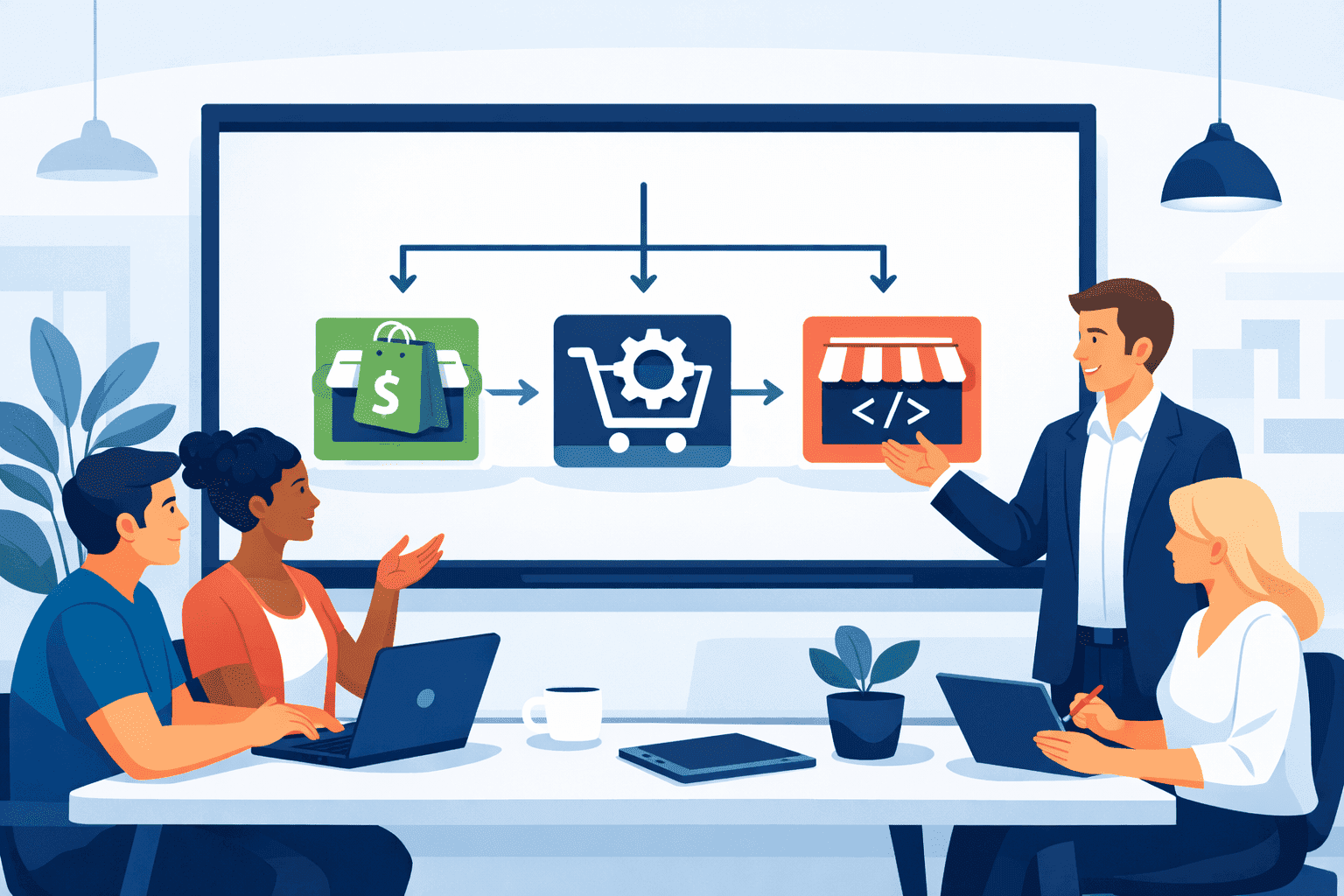
We don't pick a platform and try to fit the business into it. We evaluate the business first. Here's the framework we actually use:
Shopify — when speed beats control
Best for: Retail brands with straightforward catalogs that need to launch fast and focus on marketing, not infrastructure.
Shopify handles payments, hosting, and security out of the box. We've built stores like Ingenue and Qirdala on Shopify for exactly this reason — the brands wanted to pour their energy into product and audience, not server config.
It rents you speed.
Trade-off: You're on rented land. Pricing changes, feature deprecations, and transaction fees are on Shopify's schedule, not yours.
WooCommerce on WordPress — when content and commerce overlap
Best for: Brands where storytelling and product presentation need to breathe together, or teams already invested in WordPress.
WooCommerce is open source — you own your platform completely. We went this route with Baraka Dates and Gulf Palms, both F&B brands where the content, heritage, and product experience needed to feel like one thing, not a bolted-on cart.
You own the code.
Trade-off: More setup responsibility. Hosting, security, and updates are now your world (or your agency's). This maps closely to the CMS decision — we've written about it in depth in our CMS guide for Kuwait businesses.
Custom-built platforms — when the business model breaks the template
Best for: Businesses with unusual checkout flows, non-standard product configurations, or deep integrations with internal systems (ERPs, KNET, PACI, regional logistics).
When the business model won't fit a template, a custom build gives you full ownership and zero dependency on third-party platform decisions. Camuflage and Common Closet are two retail projects where we built the ecommerce experience from the ground up because the brand vision demanded it.
Built for you, by you.
Trade-off: Bigger investment. Needs a real development team to maintain. Here are 5 signs your business actually needs a custom web application — if even 3 apply, a custom build pays for itself.
Translation: the platform should serve the business model, not the other way around.
Teaching Clients to Make an Informed Decision
The best outcomes happen when a client genuinely understands why a particular platform was chosen for them. So we don't just hand over a recommendation. We walk through the trade-offs.
That means explaining things like:
- What does "owning your platform" actually mean?
- Why does it matter when scaling in the GCC?
- What are the real costs of SaaS versus self-hosted when you factor in transaction fees, app subscriptions, and migration risk?
- What happens to your customer data if the platform sunsets a feature?
One F&B client came to us paying around KD 180/month in Salla app subscriptions alone — before their actual platform fee. That's roughly KD 2,160/year in tooling they didn't own. When we moved them to WooCommerce, the migration paid for itself in under 8 months.
We treat this education part as mandatory, not a nice-to-have. A client who understands their platform makes better decisions long after the project's handed over.
Training That Actually Sticks
Launching an online store is only half the job. The other half → making sure the client's team can run it without needing us for every small change.
Every ecommerce project we deliver includes hands-on training tailored to the specific build. Not a generic walkthrough. We train the team on their store:
- Adding and updating products
- Managing orders and returns
- Handling inventory and stock thresholds
- Configuring shipping zones
- Running promotions and discount codes
- Reading analytics and reporting
- Responding to customer communications
Everything is documented. Every store we hand off comes with documentation specific to that build, so the team has a reference when memory fails months later.
One thing we're genuinely proud of — if a client's team needs a refresher weeks or months after handover, we run additional training sessions at no extra charge. We've done this multiple times across projects. Easier to spend an hour on a refresher than watch a client fight their own platform.
A Store No One Can Find Is Just a Website With a Cart
The best-designed ecommerce platform in the world means nothing if nobody can find it. That's why our ecommerce work always connects to the bigger picture.
Search engine optimization is part of every build. We structure product pages, categories, metadata, and internal linking so the store is discoverable on day one — not after a six-month SEO retrofit. Local SEO is the single most underrated growth channel for Kuwait businesses, and product-led stores compound that advantage fast.
For brands that need to reach customers on their phones — which is most of the GCC — we also build mobile applications that extend the ecommerce experience beyond the browser. Loyalty, push notifications, offline catalogs, app-exclusive drops.
All of this sits within our broader web design and development practice. A store that loads in 1.4 seconds, ranks on Google, and converts mobile traffic doesn't happen by accident. It's the platform choice, the architecture, and the operator training working together.
What's Coming Next for Ecommerce
The ecommerce landscape is moving fast, and AI is pouring fuel on the fire. Models like Meta's recently-announced Muse Spark are pushing multimodal AI into product imagery, intelligent shopping assistants, and context-aware recommendations. We broke down what Muse Spark actually means for business — it's a big deal for online retail specifically.
For GCC businesses, this means the bar for online retail is going up. Customers will expect smarter search, personalized recommendations, and richer product experiences as defaults — not premium features.
Here's the thing → stores built on solid, flexible foundations today will be the ones best positioned to plug in these capabilities as they mature. A rigid, locked-in SaaS solution usually can't. That's another reason we're deliberate about platform choice from day one.
Ready to Build or Migrate Your Online Store?
If you're on Salla or Zid and feeling the ceiling — write down the three features your current platform won't let you build. Bring that list to a call with us. That's usually enough signal to know whether you belong on Shopify, WooCommerce, or a custom stack.
If you're starting from zero → even better. We'd rather help you pick right the first time than migrate you in two years.
Explore our full range of services, read more from the DSRPT Think Tank, or get in touch to start the conversation. No pitch deck. No vendor bias. Just the plan.
DSRPT is a Google Premier Partner digital agency with offices in Australia and Kuwait, helping businesses across the GCC and beyond build digital experiences that perform. Learn more about what we do.