

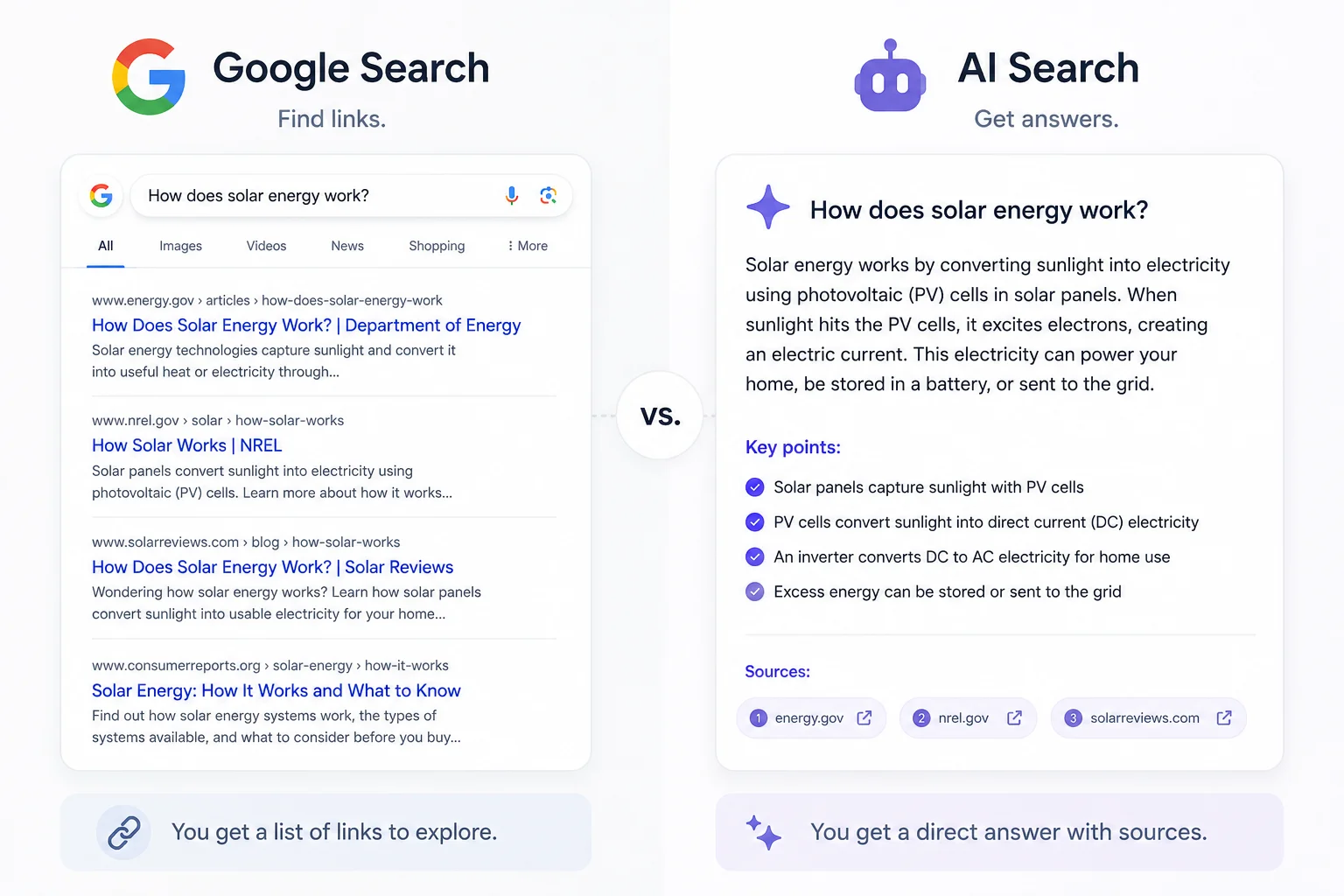
What AI search actually means
AI search is any search tool that answers your question in writing rather than listing pages that might contain the answer. ChatGPT, Perplexity, Google AI Mode, Google AI Overviews, Gemini and Claude all fall into this category.
You type a question. The tool fetches relevant current pages from the web, reads them, and writes a response that pulls the useful parts together. It normally cites the pages it used. You rarely open them.
That last sentence is the whole story. Everything else in this article is a consequence of it.
How AI search works
Three things happen between your question and the answer on screen.
It reads the question as a question
Traditional search rewards you for thinking like a machine and typing "best crm kuwait small business". AI search takes "we are a 12-person trading company in Shuwaikh, our sales team lives in WhatsApp, what CRM should we look at" and works with it. Google said in May 2026 that the average AI Mode search is triple the length of a traditional Search query.
It runs several searches, not one
Google calls this query fan-out: the model splits your question into sub-questions and issues several searches at once, then reads across the results. Ask about weeds in a lawn and it will also quietly search for herbicides, chemical-free removal and prevention. That behaviour turns out to matter a lot for whether your page gets used, and we come back to it below.
It writes the answer
The model generates prose grounded in the pages it just retrieved. The technique has a name, retrieval-augmented generation, usually shortened to RAG. Without that retrieval step a model answers from memory and goes stale. With it, the model is reading today's web. We pulled apart the machinery in vector databases explained.
AI search vs Google search: the practical differences
| Google search | AI search | |
|---|---|---|
| What it returns | A ranked list of links | A written answer |
| Who does the reading | You | The model |
| Query style | Keywords | Full questions, often long |
| Searches run per query | One | Several, via fan-out |
| Where the user ends up | On a website, usually | Still in the tool, usually |
| What you optimise for | Position in the list | Being the source the answer is built from |
| How you check your visibility | Rank tracking, Search Console | Prompt testing, brand mention tracking |
The one that catches businesses out is the last row. A ranking is a number you can look up. There is no position 3 in an AI answer. You are either in it or you are not, and the answer can differ between two people asking the same thing on the same day.
Is AI a search engine, or something else?
A language model on its own is not a search engine. It has no index, no crawler and no live view of the web. Ask a raw model a question about this week and it will answer from training data, sometimes confidently and wrongly.
What turns it into something search-like is the retrieval layer on top. Perplexity is built around that layer. ChatGPT runs real web searches before answering. Google AI Mode is grounded in Google's own index.
So the honest answer to "is AI a search engine" is: not by itself. AI search is a reading and writing layer sitting on top of a search engine. The index underneath is still doing the work of deciding which pages are worth reading, which is precisely why the old discipline of getting indexed and ranked has not gone anywhere.
Is Google search already running on AI?
Yes, and for about a decade. RankBrain went into ranking in 2015 and BERT in 2019. MUM arrived in 2021, applied to specific features rather than ranking as a whole. None of them were visible to users. They changed how Google interpreted queries, not what the results page looked like.
What changed recently is that the AI became the interface. Google launched AI Overviews in the US in May 2024. AI Mode followed. It reached English across MENA on 21 August 2025 and Arabic on 8 October 2025, in the same expansion that took it to 35+ languages. On Alphabet's Q2 2026 earnings call on 22 July 2026, Sundar Pichai said AI Mode had "surpassed 1 billion monthly active users" and that Google had "brought together AI Overviews and AI Mode into one seamless Search experience".
That merge is the part most businesses have missed. There is no longer a normal Google to opt back into.
Who owns AI search in the Gulf?
Nobody in the Gulf runs a general AI search engine, and the question is worth answering plainly because it comes up a lot.
What the region has built is Arabic-first models, and in two cases, assistants on top of them:
- Fanar, Qatar. Built by the Qatar Computing Research Institute and Hamad Bin Khalifa University, unveiled at World Summit AI Qatar on 10 December 2024. HBKU's launch announcement puts the training set at more than 300 billion Arabic words.
- HUMAIN Chat, Saudi Arabia. A Public Investment Fund company, launched August 2025 on the ALLaM 34B model, with real-time web search and multi-dialect speech input. This is the closest thing the Gulf has to a homegrown AI search product.
- Falcon-H1 Arabic, UAE. Released by Abu Dhabi's Technology Innovation Institute on 5 January 2026 in 3B, 7B and 34B sizes, topping the Open Arabic LLM Leaderboard.
Kuwait has none of its own, and the infrastructure gap is real. AGBI reported in February 2026, citing Data Center Map, that Kuwait has 5 data centres against 57 in the UAE, 51 in Saudi Arabia, 15 in Oman, 11 in Qatar and 8 in Bahrain, and calls the lack of a live hyperscale cloud region the country's biggest bottleneck. The Kuwait Investment Authority has put around $9 billion into digital services and AI over five years, on GlobalSWF's numbers, but compute on the ground is thin.
The practical conclusion for a business here: the AI search your customers actually use is American. Optimising for "Gulf AI search" means optimising for ChatGPT, Google AI Mode, Gemini and Perplexity, in Arabic and English. That is what our AI search optimization service is built around.
What the numbers actually say
This is where most articles on this topic get sloppy, so here are the figures with their sources and their limits attached.
Zero-click is now the majority case. SparkToro, analysing Similarweb panel data from January to April 2026, found 68.01% of US Google searches ended without a click to any website. Their 2024 figure, from a different panel, was 60.45%. They flag the comparison as imperfect because the panels differ, and note the 2026 data excludes the Google mobile app, where zero-click behaviour is more aggressive.
Inside AI Mode it is close to total. Semrush, with Datos, looked at nearly 69 million Google Search sessions between 1 May and 5 July 2025 and found 92 to 94% of AI Mode sessions ended with no click to an external site. Only 6 to 8% included one. Read that as US desktop only, from a period when AI Mode was tiny: 0.25% of Google sessions in early May, just over 1% by early July. It has since passed a billion monthly users.
Ranking top 10 no longer guarantees the citation. This is the finding that changed in the last year, and it is the reason this article needed rewriting. In July 2025, Ahrefs found 76% of AI Overview citations came from pages ranking in the organic top 10. In their 2 March 2026 study, across 863,000 keyword SERPs and 4 million AI Overview URLs, that had fallen to 38%. Ahrefs gives two reasons, and both matter. They improved how they parse citations between the two studies, so the datasets are not a clean like-for-like comparison. And they see AI Overviews leaning on pages surfaced by fan-out sub-queries rather than the main results page, a shift that coincides with Gemini 3 taking over AI Overviews in January 2026. Treat the direction as solid and the exact size of the fall as approximate.
AI referrals are still a rounding error. Semrush measured billions of visits across more than 50,000 websites through 2025. AI tools sent 0.14% of total web visits. Organic search sent 16.04%. AI traffic grew 66% over the year, from 462 million to 767 million monthly visits, while organic grew 2.38%.
Put those together and you get a picture that neither the panic nor the shrug describes accurately. Almost nobody is arriving from an AI tool yet. Plenty of people are deciding about you inside one.
What this means for your website
Four changes, in the order we would make them.
Answer in the first 60 words. Under every heading, put a complete, self-contained answer before any context or history. This is not a trick, it is the shape a model can lift. Open the page you most want cited and read the first paragraph under each heading on its own. If it does not make sense out of context, rewrite it.
Cover the sub-questions, not just the head term. Fan-out means the model searched for four things you did not type. If your page answers the main question and skips the obvious follow-ups, it competes for one of those searches instead of four. That is a real part of why the top-10 citation share fell.
Stop measuring the site on organic clicks alone. With 68% of searches ending in no click, session count now understates your visibility. Watch branded search volume, direct traffic and enquiry quality. A customer who read about you in an AI answer often arrives days later by typing your name. We wrote up how to actually track this in Google vs ChatGPT in 2026: track where customers find you.
Skip the AI-SEO gimmicks. Google's own guidance on optimising for generative AI features says llms.txt does nothing for Google Search, chunking your content into tiny pieces is unnecessary, rewriting pages purely for AI is unnecessary, and there is no special schema for AI features. Google's stated position is that optimising for AI search is SEO. We tested the first one specifically in does llms.txt help your website show up in AI answers.
Worth holding both ideas at once. Google says this is SEO, and Google is largely right about its own products. But the Ahrefs data says ranking in the top 10 buys you a coin flip on citation now rather than a near-certainty, and Google's guidance does not cover ChatGPT or Perplexity at all. Do the SEO. Do not assume it finishes the job.
Where to start
If you want one action from this article: pick the page that should win your most valuable question, and rewrite the first paragraph under every heading so each one answers something completely on its own. That single change does more for AI citation than any file you can upload to your server.
If you want the whole picture instead, the practical follow-up is how to rank on ChatGPT, Gemini and Perplexity, and we ran through this live with Semrush at Kuwait's first AI search event.
DSRPT is a Semrush Enterprise Partner and builds AI search visibility for businesses in Kuwait and the GCC. Talk to us about getting cited, not just ranked.
Frequently asked questions
What is AI search?
AI search is any search tool that writes you an answer instead of handing you a list of links. ChatGPT, Perplexity, Google AI Mode, Google AI Overviews, Gemini and Claude all work this way. The tool reads your question, fetches current pages from the web, and generates a written response that combines them. It usually names its sources, but you rarely need to open them, which is the part that changes how businesses get found.
How is AI search different from a normal Google search?
The difference is the output. Google search is a retrieval engine: it crawls and indexes pages, ranks them, and gives you ten links to work through yourself. AI search is a generative system: it retrieves pages the same way, then writes a single answer from them. Google search points at the answer. AI search states it. Everything else that changes, from zero-click rates to how you write a page, follows from that one difference.
Is AI a search engine?
A language model on its own is not a search engine. It has no index and no live view of the web, so without retrieval it answers from training data and can be confidently out of date. What makes ChatGPT or Perplexity behave like a search engine is the retrieval layer bolted on top: the tool runs real searches, pulls current pages, and writes from those. So AI search is a reading and writing layer sitting on a search engine, not a replacement for one.
Is Google search already powered by AI?
Yes, and it has been for about a decade. RankBrain went into ranking in 2015 and BERT in 2019, both machine learning systems that changed how Google reads a query. MUM arrived in 2021, applied to specific features rather than to ranking as a whole. What changed in 2024 and 2025 is that the AI became visible: AI Overviews launched in the US in May 2024, AI Mode followed, and on the Q2 2026 earnings call Sundar Pichai said AI Mode had passed 1 billion monthly active users and had been merged with AI Overviews into one Search experience.
Who is building AI search in the Gulf?
Nobody in the Gulf runs a general AI search engine. What the region has built is Arabic-first models and assistants: Fanar in Qatar (QCRI and HBKU, launched December 2024), HUMAIN Chat in Saudi Arabia (a PIF company, on the ALLaM 34B model, August 2025), and Falcon-H1 Arabic from Abu Dhabi's TII in January 2026. Kuwait has none of its own and has 5 data centres against the UAE's 57 and Saudi Arabia's 51, per AGBI in February 2026. In practice the AI search your customers use is American, and Google's AI Mode has answered in Arabic since October 2025.
What does AI search mean for a small business website?
Less traffic per answer, and more weight on being the source the answer is built from. Two practical changes. Put a plain, self-contained answer in the first 60 words under every heading, because that is the shape a model can lift. And stop judging the site on sessions alone, since a customer can decide about you inside an AI answer and arrive later by typing your name. Track branded search, direct visits and enquiries, not just organic clicks.