

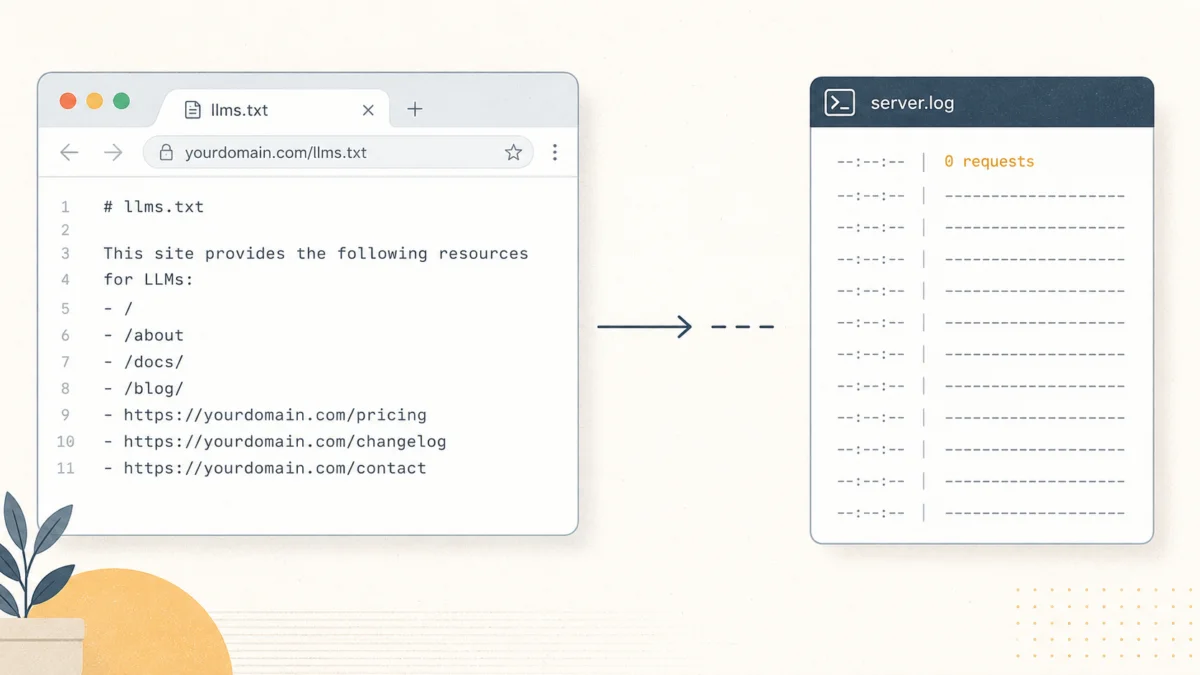
We publish an llms.txt file on this site. Go and look: dsrpt.com.au/llms.txt.
Now read the third line of it. It says this is the full link index, and that for the short curated version you should see llms.txt. The file is pointing at itself. It has been doing that for months, and nobody noticed, because as far as we can tell almost nothing has read it.
That is the honest version of the llms.txt story in 2026. Thousands of businesses have added the file because someone told them AI needs it. Very few have checked whether anything picked it up.
Here is what the evidence says, and what to do instead.
What llms.txt actually is
llms.txt is a plain text file you put at the root of your website, at yoursite.com/llms.txt. Inside it you write a short summary of what your business is, then a list of links to your most important pages with a line describing each one.
The idea, proposed by Jeremy Howard of Answer.AI in 2024, is that an AI tool could read that one file and understand your site in a few seconds instead of crawling every page.
Two things it is not. It does not block anything, so despite the name it has nothing in common with robots.txt. And it is not the same as publishing Markdown copies of your pages, which is a different tactic with its own problems.
It is a table of contents for machines. That is the whole idea.
97% of these files have never been read
In June 2026 Ahrefs published the first study large enough to settle the argument. They checked the server logs of 137,210 domains.
The numbers:
- 28% of those domains publish an llms.txt file. That is roughly 38,000 sites.
- 97% of those files received zero requests in May 2026. Not from AI. Not from bots. Not from humans. Nothing fetched them at all.
- Of the 3% that were read, 96% of the requests came from bots, and only 19.5% of those bots were AI tools of any kind.
- AI retrieval bots, the ones that fetch pages to answer a live question in ChatGPT or Perplexity, made up 1.1% of requests.
- Slackbot, the thing that generates a link preview when someone pastes a URL into a Slack channel, fetched llms.txt files more often than PerplexityBot did.
And the finding that ends the debate for most businesses: when Ahrefs looked at requests to llms.txt files that do not exist, the AI bot share was zero. Not low. Zero. No AI system goes knocking to see whether you have one. Humans do, mostly SEOs checking on competitors.
If you publish an llms.txt today, the most likely outcome by a long way is that nothing ever opens it.
Google is arguing with itself
In late May 2026, Google managed to take both sides in under a week.
Its guide on optimising for generative AI features has a section headed mythbusting. It tells site owners plainly that you do not need special files or markup to appear in generative AI search.
Days later the Chrome team shipped an llms.txt check inside Lighthouse's experimental agentic browsing audits, with documentation saying that without the file, agents may spend more time crawling your site to work out its structure.
When Lily Ray pushed Google's John Mueller on the contradiction, his answer was that llms.txt is "not done for search". He called it a temporary crutch, possibly useful for saving tokens when AI coding tools read developer documentation. He has also said flatly that no AI system currently uses llms.txt, and compared it to the keywords meta tag, which search engines abandoned decades ago.
So the Chrome team audits for it, Google Search says skip it, and Google's own search advocate calls it a crutch. That is not a standard. That is a proposal with a fan club.
The one case where it earns its keep
There is a real audience for llms.txt, and it is probably not you.
In the Ahrefs data, the biggest AI consumer of these files was not ChatGPT search or Perplexity. It was agents. Anthropic's Claude Code, the coding agent developers run in their terminal, fetched llms.txt more often than every AI retrieval bot, every AI assistant, and every training crawler except GPTBot.
That fits what the file was designed for. A coding agent reading your API documentation genuinely benefits from a clean index. It saves tokens, which saves money and time.
So the test is simple. Do your customers point AI coding tools at your documentation? If you sell an API, a developer tool, or a technical product with real docs, publish one and link to it. If you run a clinic, a restaurant group, a retail site, or a services business in Kuwait, this file is decoration.
We wrote about the wider shift toward tools acting on your behalf in MCP servers: the protocol connecting AI to your business tools. That agent layer is where llms.txt might matter one day. It does not matter today for most businesses.
The risk nobody puts in the sales pitch
Here is the part that gets left out.
llms.txt is a file that AI agents are built to read and trust. That is exactly what makes it worth attacking. In the Ahrefs study, the largest single research crawler in the dataset identified itself as prompt-injection-survey. Somebody is already systematically studying llms.txt files as a way to plant instructions that agents will swallow.
If a bad actor edits your file, or if the platform that auto-generates it gets compromised, every agent that reads it gets misled in your name.
If you publish one, treat it like code. Put it in version control. Restrict who can edit it. Keep the contents to plain links and descriptions with nothing that reads like an instruction. Only link to pages you control. And read whatever your website builder generated for you, because Wix, Framer and Lovable are all now producing or scanning for these files by default.
What actually gets you into AI answers
None of this means AI visibility is out of your hands. It means the file is the wrong lever.
The things that move the needle are the same ones we keep writing about, because they keep working:
- Answer the question in the first two sentences of the page. AI systems quote paragraphs that stand on their own.
- Publish real numbers. Prices, ranges, timelines. The single most common reason a page loses a citation to a competitor is that the competitor published a figure and you wrote "contact us for a custom proposal".
- Keep your business details identical everywhere: your site, your Google Business Profile, your directory listings. Contradictions make you a weaker entity.
- Make sure your structured data is valid, not just present. We have audited sites where every schema block on 151 pages was broken by a templating bug. Present and working are different things.
- Get mentioned on the third-party pages AI already cites in your category. In most Kuwait searches those are listicles and directories, not agency websites.
We covered the mechanics of this in how to rank on ChatGPT, Gemini and Perplexity: a Kuwait business guide to GEO, and if you are still working out how these tools differ from a normal Google search, start with what is AI search and how is it different from Google search.
What to do now
Three moves, in order.
Open your own server logs and filter for llms.txt. If you already publish one, you will most likely see nothing. That takes five minutes and it settles the question for your site specifically, which beats any study.
Then start measuring where your customers actually find you, because you cannot improve a channel you are not tracking. Google vs ChatGPT in 2026: track where customers find you walks through the setup.
Then put the effort into the pages themselves. If someone is selling you an llms.txt file as an AI visibility service, that is a signal about the rest of their offer. We wrote about spotting that pattern in SEO agency Kuwait: what actually works and what's a waste of money.
And yes, we are going to fix our own file. It is a five-minute job, and after nearly two years of the industry arguing about llms.txt, that is roughly what the whole thing is worth.
Sources and further reading
Everything above is checked against primary sources. If you want to read them yourself:
- llmstxt.org. The original llms.txt proposal from Jeremy Howard, including the format specification.
- We analyzed 137K sites: 97% of llms.txt files never get read. Ahrefs, June 2026. The server log study behind every number in this post.
- Google Search: AI features and your website. Google's official guidance, including the mythbusting section on special files.
- llms.txt audit in Lighthouse agentic browsing. The Chrome team's documentation for the audit that checks for the file.
- Google says no AI system currently uses llms.txt. Search Engine Roundtable's writeup of John Mueller's comments.
- Google says llms.txt is purely speculative for now. Search Engine Journal on the same statements.
- Google crawlers and fetchers. The official list, and where you will find that Google-Extended is a robots.txt token rather than a crawler with its own user agent.