

A SaaS founder in Kuwait emailed me last quarter, panicked. "ChatGPT is killing my SEO traffic." He'd read three viral threads and was about to fire his SEO agency.
I asked him to pull his Google Analytics. His Google traffic was up 18% year-over-year. ChatGPT and Perplexity were sending him a combined 6% of total visits, and converting at almost double his Google rate. He didn't have a Google problem. He had a measurement problem.
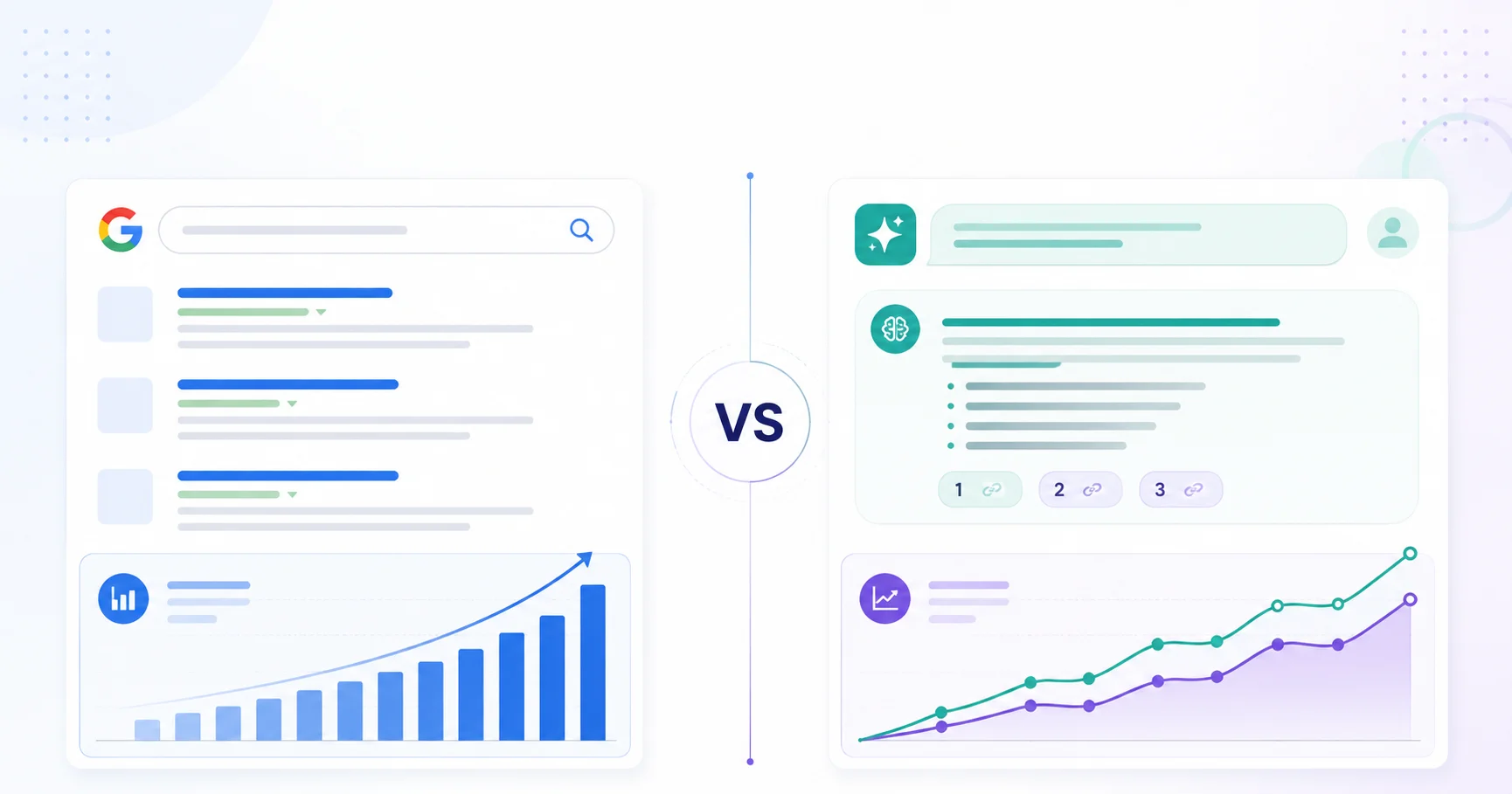
Most "is Google dead?" content is written for clicks, not for business owners trying to make decisions. The real question is how to measure where your customers actually find you, then optimize accordingly. Which one "wins" doesn't pay your bills.
Here's the practical version.
The actual 2026 search traffic mix
Stripping out the hype, the rough share of search-driven traffic for a typical small-to-mid Kuwait business in 2026 looks something like this:
| Channel | Approx. share of search traffic | Trend |
|---|---|---|
| Google organic (traditional results) | 55-70% | Slightly declining |
| Google AI Overviews / Gemini in-Google | 5-15% | Growing fast |
| ChatGPT (ChatGPT Search, web mode) | 3-10% | Growing fast |
| Perplexity | 1-5% | Growing |
| Microsoft Copilot / Bing | 1-4% | Stable |
| Other AI tools (Claude, You.com, etc.) | <2% | Marginal |
Numbers vary wildly by industry, language, and audience. B2B SaaS with English-speaking founders skews higher on AI referrals. Local consumer businesses skew almost entirely Google. Bilingual Kuwait business sites typically sit somewhere in between, with AI search growing in English queries faster than Arabic ones, though Arabic AI search is catching up fast through 2026.
The point is: AI search is not zero, and it's not killing Google. Both are sending traffic. You need to measure both.
Where Google still wins decisively
Don't let the AI hype confuse you. Google still dominates these search shapes:
- → "Near me" queries like "restaurants near me", "dentist Salmiya", "phone repair Hawally". Google Maps and Business Profile crush AI here.
- → High-commercial-intent searches like "buy", "price", "book", "subscribe". Google's purchase intent matching is still better than any AI assistant.
- → Local discovery and reviews through Google Business Profile, reviews, photos, hours. AI assistants increasingly cite these but the base data lives in Google.
- → Real-time information like news, scores, weather, flight status. AI tools are catching up but Google still wins.
- → Transactional searches, anything with a dollar or dinar sign attached.
If your business depends on any of these intents, and most consumer Kuwait businesses do, Google is still the priority channel. The full local-search angle is in Local SEO Is the Most Underrated Growth Channel in Kuwait.
Where AI search is genuinely eating into Google
Where AI assistants are taking real share:
- → Comparison queries like "best CRM for small teams", "Notion vs Obsidian", "Shopify vs WooCommerce". These now get answered inside the AI chat, often without the user clicking through to any website.
- → Multi-step research like "I'm planning a wedding in Kuwait, what do I need", where the AI synthesises rather than serving 10 blue links.
- → Conversational follow-ups, drilling deeper into a topic with five rounds of questions. AI handles this natively. Google forces a new search each time.
- → Code, technical, and how-to queries. Developers and technical users have largely moved off Google for these.
If your traffic was historically driven by informational long-tail queries, you've probably already felt this shift: fewer impressions, fewer clicks, but the visitors that do come are more qualified.
How to actually measure where your traffic comes from
This is the part most founders skip and then complain about. Set this up in 30 minutes and you'll know more about your traffic than 90% of your competitors.
Step 1: Add an AI-referral segment in your analytics
In Google Analytics 4 (or Plausible, Fathom, Matomo, same idea), create a custom segment that filters referrer hostnames:
chatgpt.comperplexity.aichat.openai.comgemini.google.comcopilot.microsoft.comclaude.ai
Save it as an "AI Referrals" segment. Apply it across all your key reports.
Step 2: Tag UTM-tracked links inside any AI-friendly content
If you publish content people are likely to ask AI assistants about, embed UTM-tagged outbound links in the page itself. When those get cited and clicked through, you'll see the source even if AI tools strip referrers in the future.
Step 3: Track Google AI Overviews separately
Google AI Overviews show up as standard organic Google traffic in analytics. Search Console treats them as their own appearance type. Check Search Console → Performance → Search Appearance → "AI Overviews" if available. That's where you see the actual impression and click split.
Step 4: Set conversion tracking on every channel
The trap is comparing channels by visit count. AI traffic is usually lower volume but higher intent. Track conversions per channel (leads, sales, sign-ups) and compare conversion rates, not just visit counts. AI referrals routinely convert 1.5 to 3x better than equivalent Google organic visits in the businesses I've measured.
That's the framework. It's boring. It works.
What to actually do with the data
Once you can see the split, the optimization plays write themselves:
-
If AI referrals are >5% of your traffic, invest seriously in GEO (Generative Engine Optimization). The full Kuwait-specific playbook is in How to Rank on ChatGPT, Gemini and Perplexity.
-
If AI referrals convert better than Google organic, that's your highest-ROI growth lever. Build content specifically structured to be AI-citable: clear definitions, FAQ blocks, structured data, summarisable answers.
-
If your Google traffic is declining but AI traffic is growing, don't panic. Run the math on combined revenue first. The shift is normal, and the loss is usually compensated.
-
If both are flat or declining, the issue is content quality or technical SEO, not the AI vs Google debate. Audit fundamentals first. Our Complete Guide to Creating a Website That Google Loves covers the basics that serve both channels.
The mistake most agencies are making right now
I see Kuwait agencies pitching "we'll get you ranked on ChatGPT" as if it's a separate service to traditional SEO. It mostly isn't. The same fundamentals (quality content, fast pages, clear structure, authoritative signals) drive both. The differences are in emphasis, not direction.
The real new skill is content structuring for citability: writing in a way AI tools can extract clean answers from. That's the part most legacy SEO playbooks haven't internalised yet. We covered the broader picture in Do I Still Need a Website in the New AI Era?.
Anyone selling you "ChatGPT SEO" as a standalone product without first auditing your traditional SEO is selling vibes.
What ChatGPT's own browser changes
OpenAI's Atlas browser, launched late 2025, makes AI search a default for many users instead of something they opt into. That accelerates the share shift. It also makes AI referral tracking more important, because more sessions will originate inside AI surfaces. We unpacked the strategic implications in ChatGPT Browser Atlas: OpenAI's Revolutionary AI-Powered Web Browser.
If you're not measuring AI referrals by mid-2026, you're flying blind on a channel that may already be 10% of your acquisition.
What to do this week
Pick the lowest-effort, highest-leverage steps:
- Create the "AI Referrals" segment in your analytics today (30 minutes)
- Pull last 90 days. Note the actual share. It's almost certainly higher than you guessed.
- Check Google Search Console for the AI Overviews appearance type
- Identify your top-converting AI-referral pages. Those are the templates to replicate.
- Compare conversion rates by channel, not visits
- If AI is converting better, invest in GEO content structure this quarter, not paid ads
The Kuwait businesses that figure this out in 2026, while AI traffic is still relatively small, will own the channel by 2027 when it's 2 to 4x larger.
If you want a 30-minute walkthrough of what your specific analytics data is actually telling you about Google vs AI traffic, book a call with our team. We'll show you the segments, find the gaps, and tell you which channel deserves your next dollar.