

Two Kuwait businesses can ask for "the same" custom software and get quotes that differ by a factor of five. That's not one of them padding the number. It's almost always that the quotes are pricing different things: different scope, different integrations, different teams, sometimes a different definition of "done."
Here's what actually moves the number on a custom software project in Kuwait, why fixed price isn't automatically the safe choice, the hidden costs most quotes leave out, and how to bring a number down without cutting something you'll regret.
The big three: scope, integrations, and team
Scope and complexity. A focused internal tool with a handful of screens is a fundamentally different project from a customer-facing platform with dashboards, multi-user permissions, and automation. The gap between those two isn't 20% or 50%, it's often several times over, because complexity compounds: more screens means more edge cases, more edge cases means more testing, more testing means more hours.
Integrations. Every integration you add, whether it's KNET for payments, PACI for identity checks, or just your existing accounting system, adds real development time on top of the core build. Some integrations are a clean API call. Others come with approval processes, compliance requirements, and testing against a live production system that a generic feature never touches.
Team. Who builds it changes the number as much as what's being built. A senior local team, an offshore team, or some mix of both all come with different hourly rates, different communication overhead, and different familiarity with Kuwait-specific requirements. None of these is automatically the "expensive" or "cheap" option once you account for how fast each one actually gets to a working, tested product.
What makes a Kuwait project cost more than it looks like it should
A few things specifically catch Kuwait businesses off guard when a quote comes in higher than expected:
- Local integrations get treated as an afterthought in the initial estimate. KNET and PACI both come with real process and compliance overhead that a developer unfamiliar with them won't have budgeted for, so the number grows once the real work starts.
- Bilingual requirements aren't scoped from day one. Arabic support, right-to-left layout, and dual-language content structure are real design and development work, not a checkbox added at the end, and pricing it in late means re-doing parts of the build.
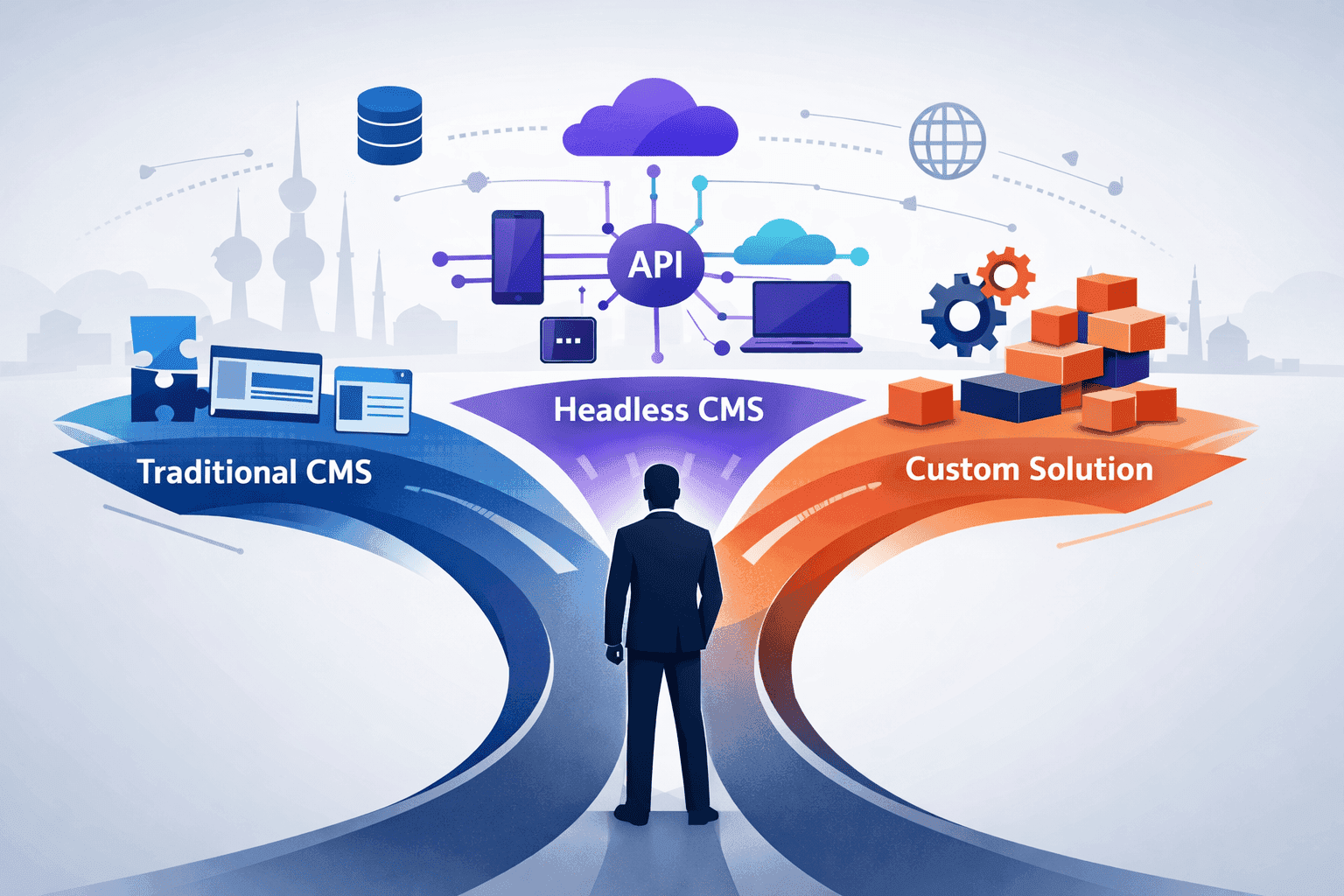
- "Custom" gets used loosely. Sometimes what's actually needed is a configured off-the-shelf platform, which costs a fraction of a ground-up build. A quote for full custom work when configuration would do is the most avoidable version of "cost more than it should."
- Compliance and security work shows up late. Anything touching personal data, payments, or regulated processes needs security and compliance work built in from the start. Retrofitting it after the fact typically costs more than planning for it upfront.
Fixed price vs time and materials: which one actually costs you more
Fixed price feels safer because you know the number going in. In practice, that certainty has a cost: vendors typically build a 15 to 30%+ risk premium into a fixed quote to cover their own uncertainty about what might go wrong. Any change to scope after signing usually means a formal change order, which is slower and pricier than adjusting an in-progress sprint. And when a fixed-price project runs into unexpected complexity, the incentive shifts toward cutting corners to protect the vendor's margin, not toward doing the work properly.
Time and materials (T&M) removes the risk premium and lets you pay for what the work actually takes, which can mean paying less overall if the project goes smoothly, and it makes it easier to adjust direction based on what you learn along the way. The tradeoff is that it needs real involvement from you: regular check-ins, a not-to-exceed cap on spending, and visibility into the team's actual progress, not a number you sign once and forget.
As a rough guide: fixed price fits a small, well-defined project with requirements that genuinely won't change. T&M fits anything with real complexity, discovery, or a good chance requirements will shift once you see the product taking shape, which describes most custom software builds.
The hidden costs most quotes leave out
The initial number in a proposal rarely covers the full cost of owning the software. The ones that catch people out most often:
- Ongoing maintenance. Bug fixes, security patches, and updates after launch can add up to a large share of a system's total cost over its life, sometimes rivaling or exceeding the original build cost over several years.
- Scope creep. Reasonable-sounding feature additions during the build stretch the timeline and the budget past the original estimate, one small request at a time.
- Integration work that's harder than it looked. Connecting to an existing system or a third-party API often surfaces complexity nobody scoped for until the integration is actually attempted.
- Compliance and security retrofits. Addressing these late in the project, instead of designing for them from the start, is consistently more expensive than planning ahead.
- Infrastructure that scales with usage. Hosting, storage, and bandwidth costs grow as the software gets more users, which a one-time development quote won't reflect.
Ask directly what happens after launch: who owns bug fixes, what a security patch costs, and what a not-yet-scoped feature request costs to add later. If a proposal doesn't answer this, that's the number you'll be surprised by in six months.
How much each factor actually moves the number
| Factor | What it adds |
|---|---|
| Feature complexity | A simple, focused tool sits at one end; adding dashboards, multi-entity support, or heavy automation can multiply the build several times over |
| Each integration | Meaningful integrations (KNET, PACI, existing systems) each add a real block of development time, more if compliance or approval steps are involved |
| Security and compliance | Can add roughly 10 to 30% to total project cost, more for anything handling regulated data |
| UI/UX polish | A basic interface takes a fraction of the time a polished, enterprise-grade design needs |
| Scalability requirements | Building for growth from day one typically adds another 20 to 30% in performance and infrastructure work |
For context, broad 2026 market ranges for custom software in Kuwait run from roughly KD 4,600 to 9,300 for basic internal tools, KD 9,300 to 21,600 for mid-level business software like CRMs or portals, and KD 21,600 to 46,300+ for complex or enterprise systems, with most projects taking 3 to 6 months. Every factor above is what pushes a given project toward the top or bottom of its tier, not the tier itself.
How to control cost without cutting the wrong corner
The instinct when a quote comes in too high is to cut evenly across the board. That's usually the wrong move. A better approach:
- Cut scope, not depth. Ship the smallest version that solves the actual problem, and add the nice-to-have features in a second phase once the core is working and paying for itself.
- Plan integrations from the start, even the ones you'll build later. Knowing you'll eventually need KNET or a specific system integration changes how the core is architected, and retrofitting it later almost always costs more than building for it from day one.
- Don't cut testing or security to hit a number. These are the corners that turn into the most expensive rework later, often after real damage is already done.
- Get a blended hourly rate from every team you're comparing, whether they're quoting fixed price or T&M, so you're comparing the same thing rather than two different pricing structures dressed up as a single number.
Related reading: Dsrpt's think-tank has more on when you actually need custom software versus something off the shelf, and a broader look at where to start with a custom software project in Kuwait.
Where this leaves you
Before you ask for a quote, write down the actual scope, every integration you know you'll need, and whether bilingual support applies. Bring that to two or three teams, ask each one for a blended hourly rate and what's included after launch, and compare those answers directly against each other rather than just the bottom-line number. That's what actually tells you which quote is real.