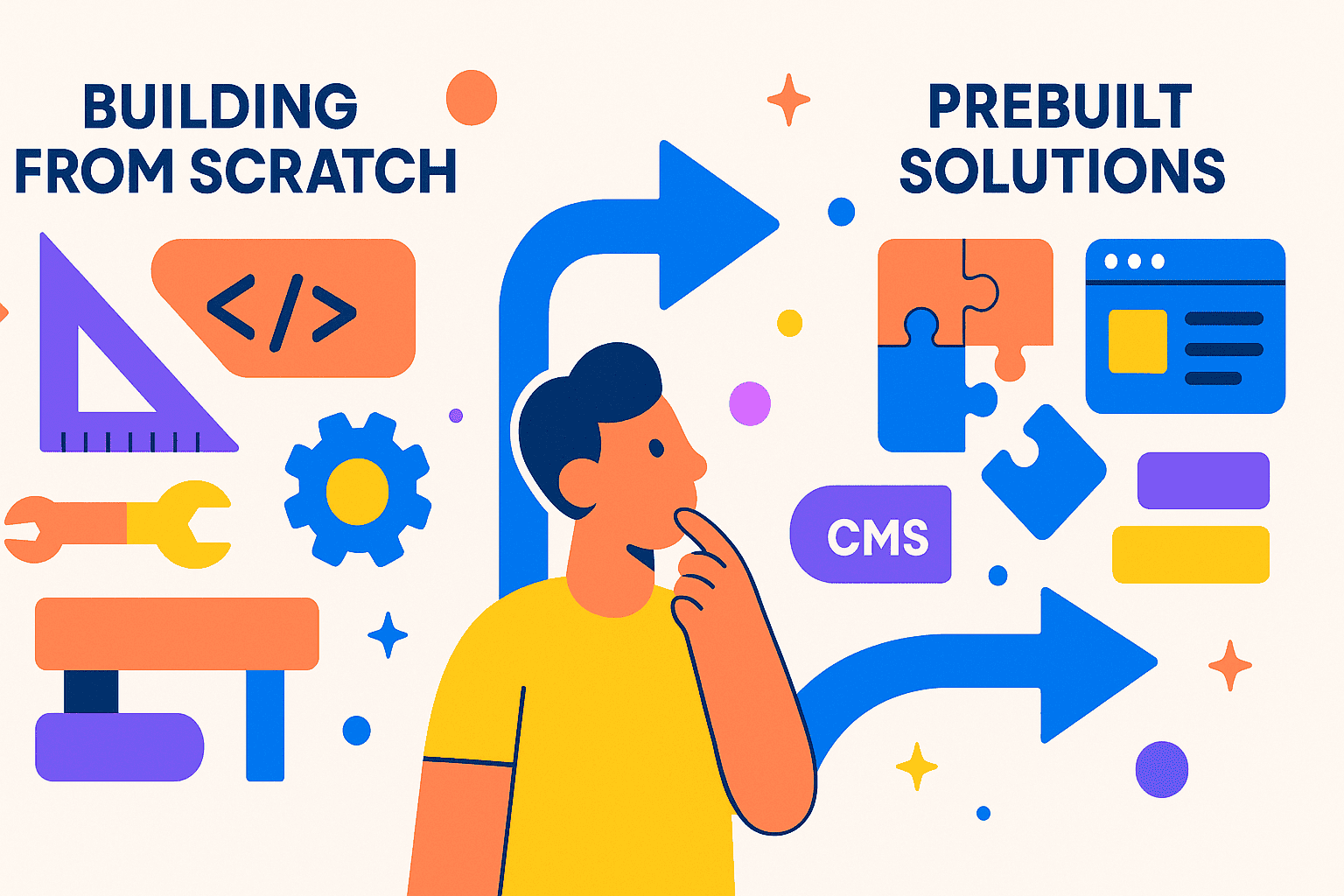


Start by figuring out which of three things you actually need: custom software built from scratch, an existing platform configured to fit your business, or an off-the-shelf tool you just buy and use as it comes. Most Kuwait business owners who walk into a software house asking for "custom software" actually need one of the other two, and figuring out which before you talk to a developer saves you months and a real amount of money.
Here's how to tell the three apart, what genuinely pushes a Kuwait business toward custom, the local pieces (PACI, KNET, government registries) that generic development guides never mention, what custom software actually costs here, and what to check before you sign anything.
Custom, configured, or off the shelf: which one are you actually asking for?
Off the shelf means you sign up and use the product as built. Shopify for a storefront, QuickBooks for accounting, Zoho for a CRM. You get updates for free, you pay per user or per month, and you adapt your process to the tool, not the other way around.
Configured means you take an existing platform, like Odoo, Salesforce, or WooCommerce, and set it up around your business: custom fields, workflows, permissions, maybe a few plugins. No one is writing new core code. This is faster and cheaper than custom, and it covers more businesses than people assume.
Custom means someone writes software specifically for how your business runs, from the ground up. No platform underneath it that you're renting.
A quick test: if you can name two or three companies already selling a product that does most of what you need, you don't need custom. You need configuration, or you need to accept the 20% gap and move on. Custom is for the businesses where that search comes up empty, or where the gap actually costs more than a build would.
What actually pushes a Kuwait business toward custom
A few patterns show up again and again:
- Your workflow doesn't match what any existing product assumes. A distributor juggling multiple currencies, consignment stock, and split warehouses often finds that QuickBooks or Zoho can model maybe 70% of that cleanly, and the other 30% turns into spreadsheets and manual reconciliation every month.
- You're stitching together several disconnected systems (a POS, a supplier portal, an accounting tool) that were never meant to talk to each other, and you need one internal tool that actually does.
- You're building a product to sell to other businesses, not a tool to run your own. At that point "off the shelf" isn't even on the table.
- An off-the-shelf tool gets you 80% there, but the remaining 20% is where your team spends most of its manual hours. If that gap costs more in labor over a year than a build would cost once, custom starts to make financial sense.
- You need something an off-the-shelf platform in Kuwait's market doesn't handle out of the box: a specific KNET payment flow, an identity check against PACI, or reporting formats a Kuwait regulator expects.
[If you've got a real example from a Dsrpt project that fits one of these, swap it in here.]
The Kuwait-specific complications no generic guide will tell you
Most "how to build custom software" content is written for a US or European market and skips straight past the parts that actually slow a Kuwait project down.
KNET. Kuwait's national payment gateway, run by the Shared Electronic Banking Services company, is the one payment rail almost every local e-commerce or POS project needs. It's well documented: there's a direct integration path if your bank sponsors it, and several third-party gateways (MyFatoorah, Tap, among others) sit on top of KNET if you'd rather not deal with the direct integration and its approval process. Ask any developer quoting you an e-commerce build which route they're proposing and why, because the two have very different timelines.
PACI. The Public Authority for Civil Information runs Kuwait's central identity and residency registry, keyed to the 12-digit Civil ID. For low-volume, back-office lookups, a manual check on paci.gov.kw is fine. For anything automated, like verifying a customer or employee during onboarding, you request API access through PACI or a licensed middleware vendor, authenticate with OAuth or a token, and get a structured response back. This comes with real compliance weight: user consent before you access their data, audit trails, encrypted logs, and alignment with CITRA's cybersecurity framework, including keeping the data in Kuwait. If your project touches identity verification, this step alone can add weeks that a rushed quote won't have accounted for.
Sahel. This is the one people misname most often. Sahel is the government's own app for citizens and businesses (a Sahel Business version exists too), and it has handled well over 100 million transactions since launch. But it isn't a platform third-party software plugs into. There's no public developer API for Sahel the way there is for PACI. When a client asks "can this integrate with Sahel," what they usually mean is the underlying government service, most often PACI identity verification or a Ministry of Commerce registry check, that happens to also be accessible through the Sahel app for citizens. A software house that understands this will ask you which specific government data or service you actually need, not just say yes to "Sahel integration."
Data and hosting. E-commerce and fintech-adjacent builds in Kuwait increasingly run into data localization expectations. Ask early where your data will physically sit, and whether that matters for your industry.
Build vs buy vs customize: the real cost comparison
Off the shelf is cheapest to start: little or no upfront cost, a recurring per-user fee, and you're renting someone else's product roadmap for as long as you use it.
Configuring an existing platform sits in the middle: an implementation fee on top of a subscription, usually a fraction of a full custom build, and still fast to launch. Most businesses outgrow this option before they outgrow off-the-shelf, if they outgrow it at all.
Custom software has the highest upfront cost and the widest range, because "custom" covers everything from a simple internal dashboard to a full ERP. Rough 2026 market ranges for the Gulf region look like this:
- Basic internal tools (dashboards, workflow automation): KWD 2,000 to 5,000
- Mid-level business software (CRM, inventory, customer portals): KWD 5,000 to 20,000
- Complex or enterprise systems (full ERP, AI-heavy platforms): KWD 20,000 to 50,000 and up
All depends on the scope
Most projects in that range take 3 to 6 months, longer if several local integrations are involved. These are broad market figures, not a quote, and any real proposal should break down where your specific number comes from.
The comparison that actually matters is the 5-year one, not the first-invoice one. Add up what off-the-shelf or configured software will cost you in subscriptions and per-seat fees over five years, including the manual labor spent working around its gaps. For a small, stable team, that number usually stays below a custom build's cost. For a team that's growing fast or has workflows the software fights against every day, the lines cross sooner than most people expect.
What to check before you sign a custom software contract
A few things belong in writing before any deposit changes hands:
- Who owns the source code and IP once the project is paid for. This should be you, stated explicitly, not assumed.
- What "done" means for each milestone: written acceptance criteria, not a general description of a phase.
- Payment tied to those milestones, not just a deposit up front and one invoice at the end.
- Who hosts the software and who holds admin access after handover.
- What you get if the developer stops working on the project mid-way: the current codebase, documentation, and credentials, not just a promise.
- What post-launch support is included, what gets billed separately, and for how long.
- If a local integration like KNET or PACI is marked "done," whether that means tested against production, or just code that's been written and never run against the live system.
How to tell a real software house from one guessing at a timeline
A few signals separate a team that's actually done this before from one reading off a template:
They ask about your workflow in detail before they give you a number, not after. They can explain why a project takes 3 months instead of 6, tied to specific pieces of scope, rather than quoting a round figure. They show you a past build with real screens and real outcomes, not a portfolio slide. They bring up KNET, PACI, or hosting and data residency requirements without you having to ask, because they've hit those walls before. They offer a fixed-scope contract with defined milestones, not an open-ended "we'll figure it out as we go" arrangement. And if your project clearly needs a local integration, like an e-commerce store that will obviously need KNET, and their quote doesn't mention it at all, that's worth a direct question before you sign anything.
Related reading: Dsrpt's think-tank has a longer breakdown of when you actually need custom software, what Kuwait's e-commerce rules require of online sellers, and an honest buyer's guide to picking a development company in Kuwait.
Where this leaves you
If you're still not sure which of the three you need, that's normal, and it's exactly the conversation worth having before any contract gets signed. Write down your actual workflow, the specific gap an existing tool leaves open, and any Kuwait-specific system it needs to talk to. Bring that to a software house, Dsrpt or otherwise, and a real one will tell you honestly if you need custom at all, or if a configured platform gets you there for a fraction of the cost.