

Search Clutch for AI companies in Kuwait and you get 11 names. The first six are based in India, Pakistan and the US. Most want at least USD 10,000 before they start.
That's not a reason to avoid them. It's a reason to ask better questions, because "AI agency" now covers everything from a freelancer wiring ChatGPT into a WhatsApp number to a team that builds and runs software for years. The label tells you nothing. The answers to seven questions tell you most of what you need.
We build AI into client software at dsrpt, so yes, we'd like your business. This guide is written so you can judge us with it too.
What an AI agency in Kuwait actually builds
Before comparing proposals, know which kind of project you're buying. Most AI solutions sold in Kuwait fall into one of these:
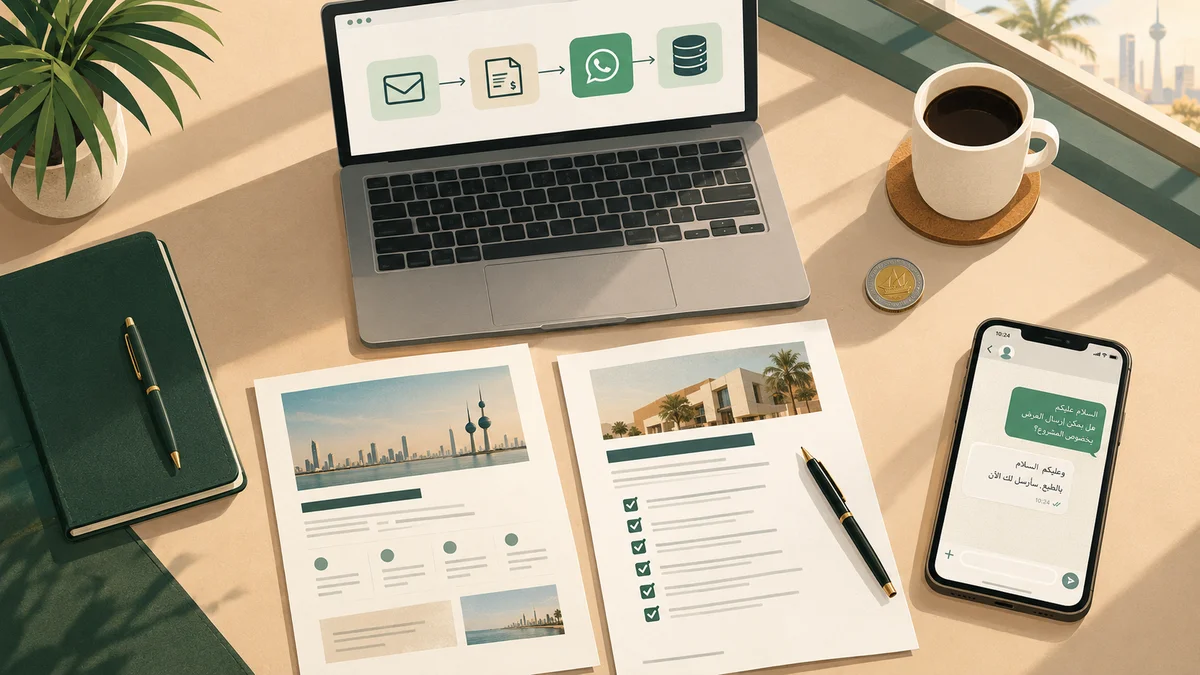
- Workflow automation. Emails sorted and answered, invoices read into your accounting system, leads scored and routed to the right salesperson. Least exciting, most likely to pay for itself.
- Assistants on your own data. A chat window that answers from your policies, product catalogue or order history instead of the open internet.
- Document processing. Contracts, civil ID scans, delivery notes and PDFs turned into structured data.
- Computer vision and physical analytics. Cameras and sensors that count people, measure dwell time or spot defects.
- Custom models. Training your own model. Rarely what a Kuwait SME needs, and often sold when an off-the-shelf model would do.
There's also a separate service that shares the word "AI": getting your business named inside ChatGPT and Gemini answers. That's a marketing job, not a build, and we cover it in our guide to ranking on ChatGPT, Gemini and Perplexity. Don't let one proposal blur the two.
Question 1: Can I see one running in production?
Not a demo. A demo runs on clean sample data with the person who built it at the keyboard. Production means real staff, messy inputs, and a Tuesday afternoon when the API is slow.
In August 2025 an MIT group published a report claiming 95% of company generative AI pilots produced no measurable return. The study is weak. It rests on 52 interviews, and critics picked the method apart within days. But the pattern it describes is real: plenty of AI projects look great in the meeting and never make it into daily work.
So ask for one live system, a named or anonymised client, and ideally ten minutes with someone who uses it. If an agency has only built prototypes, that's fine for a prototype budget. It's not fine for a production price.
Question 2: Where does my data go?
Every AI system sends your data somewhere. Customer messages go to a model provider, files go to storage, logs go to a server. Ask for a one-page answer that names each place and the country it sits in.
This matters more in Kuwait than in Dubai or Riyadh. An AGBI analysis in February 2026 counted 5 data centres in Kuwait against 57 in the UAE and 51 in Saudi Arabia. Google announced a Kuwait cloud region in January 2023 and still hasn't given an opening date. In practice, most AI processing for Kuwait businesses happens outside Kuwait.
That can be fine. But you should decide it, not find out later. CITRA's Data Privacy Protection Regulation (Resolution 26 of 2024) sets the local standard: explicit consent before collecting personal data, notices in Arabic and English, and reporting a breach to CITRA within 24 hours. It applies directly to CITRA-licensed telecom and IT providers, and it's the obvious yardstick for everyone else. Banks, clinics and anyone handling civil ID numbers should expect their own regulator to ask the same questions.
A good agency has an answer ready. A weak one says "it's all encrypted" and changes the subject.
Question 3: How does it handle Kuwaiti Arabic?
The big models are good at Modern Standard Arabic. Customers in Kuwait don't write in Modern Standard Arabic. They write in Gulf dialect, switch to English halfway through a sentence, and type Arabizi ("shlonik, wain el order?").
Don't accept a slide that says "supports Arabic". Pull 50 real messages from your WhatsApp or inbox, remove the personal details, and ask the agency to run their system against them before you sign. You'll learn more in an hour than in three sales calls.
Question 4: What happens when it's wrong?
It will be wrong. That's normal for AI. What matters is what happens next.
Ask them to show you three things:
- How a human takes over when the AI isn't confident or the customer is angry.
- Where every AI decision is logged, so you can check why it did what it did.
- What the AI is not allowed to do on its own, like refunds, cancellations or anything involving money.
If the answer to all three is "the model is very accurate", keep looking.
Question 5: What does it cost every month, not just to build?
AI systems keep costing money after launch. Every message or document goes through a paid model. Hosting, monitoring and model updates are extra. A chatbot that costs a few dinars a day in testing can cost hundreds a month at real volume.
For a reference point, Clutch's Kuwait AI list shows most firms at a USD 10,000 or 25,000 minimum project, with USD 25 to 49 an hour as the most common rate. A good proposal gives you both numbers, the build price and an estimated monthly running cost at your volume, plus what happens to that cost if volume doubles.
Question 6: Who owns the accounts and the code?
Ask whose name is on the OpenAI, Anthropic or Google account, the hosting account and the code repository. It should be yours, or at least be handed to you when the contract ends.
We've taken over enough projects where the previous agency held every key to know how this goes. The system works fine until the relationship ends, then nobody can change a prompt, renew a card, or even find the server. Put ownership in the contract before the build starts.
Question 7: Have they looked at my data yet?
The best agencies ask to see your data before they quote. The data you have decides what's possible, whatever the brochure says.
Here's a real example. A GCC maintenance company asked us for an app that would pull live data from equipment they'd been told had "AI and APIs". Before scoping anything we checked each manufacturer. Two of their seven brands had any connected system at all. The rest meant retrofitting hardware or having technicians enter data by hand. So phase one became a field service app that works with no live data, and the connected features moved to phase two. Their budget went on something they could use in months, not on promises from equipment makers.
An agency that quotes a fixed price without asking a single question about your data is quoting for a demo.
Red flags worth walking away from
- A guaranteed percentage of time or cost saved, before they've seen your process.
- "We'll train a custom model" for a problem an existing model already handles.
- No written answer on where data is stored.
- A price with no monthly running cost attached.
- The agency keeps the model and hosting accounts in its own name.
- Every case study is a prototype, a hackathon project or a concept video.
Where DSRPT fits
DSRPT is a software and digital agency working from Kuwait and Australia. Our AI work sits inside the software we build: automations, integrations and dashboards connected to systems businesses already run.
The clearest public example is GoAI at Tamdeen Entertainment. GoAI units at the entrances, activity zones and F&B outlets measure anonymous footfall, dwell time and movement, with processing done on the device and no video stored. Within three months, revenue per visitor was up 30%+ and peak hour conversion 28%+, and time spent in dead zones fell 29%. For businesses that want to show up in AI answers instead, that's our AI search optimization service.
If you're not sure whether your idea needs AI at all, start with the custom software question first. Sometimes the honest answer is a spreadsheet and a better form.
What to do next
Pick the one process that eats the most staff hours every week. Write down how it works today, how many times it happens and what a mistake costs. Then send that page to two or three agencies with these seven questions attached.
The replies will sort themselves. The good ones will ask you for data. The rest will send you a deck.
Frequently asked questions
How much does an AI agency in Kuwait charge?
There is no published Kuwait price data. On Clutch's list of AI companies serving Kuwait, most firms set a minimum project of USD 10,000 or 25,000, and the most common hourly rate is USD 25 to 49. A small automation can cost far less than that. Always ask for two numbers, the build price and the monthly running cost, because model usage and hosting keep charging after launch.
What is the difference between an AI agency and a software company?
Very little in practice. Most useful AI work is ordinary software with a model inside it. It needs a database, integrations, user logins, error handling and hosting. An AI agency that cannot build the software around the model will hand you a demo that nobody can use at work. Ask to see the finished product, not only the AI part.
Is it legal to send my customer data to ChatGPT or other AI services from Kuwait?
Kuwait has no single AI law yet. CITRA's Data Privacy Protection Regulation (Resolution 26 of 2024) requires explicit consent before collecting personal data, notices in Arabic and English, and reporting a breach to CITRA within 24 hours. It applies directly to CITRA-licensed telecom and IT providers. Whatever your sector, your agency should be able to tell you in writing where each piece of data is sent and stored.
Can AI chatbots understand Kuwaiti Arabic?
The big models handle Modern Standard Arabic well and Gulf dialect less evenly, especially when a message mixes Arabic, English and Arabizi. The only reliable test is your own data. Give the agency 50 real customer messages and ask them to run the system against them before you sign anything.
How long does an AI automation project take in Kuwait?
A single workflow, like sorting incoming emails or pulling data out of invoices, can be live in two to six weeks once access to your systems is sorted. Projects that need clean data, several integrations or staff training take months. Getting access and data from your existing systems is usually the slow part, not the AI itself.