

On 9 July 2026, OpenAI moved its GPT-5.6 family out of preview and into general availability. Three models, one generation, and a clear message: get more useful work out of every token.
Here is what shipped, and the part most launch coverage skips: what a business shipping real software should actually do about it.
Three tiers, and the names now matter
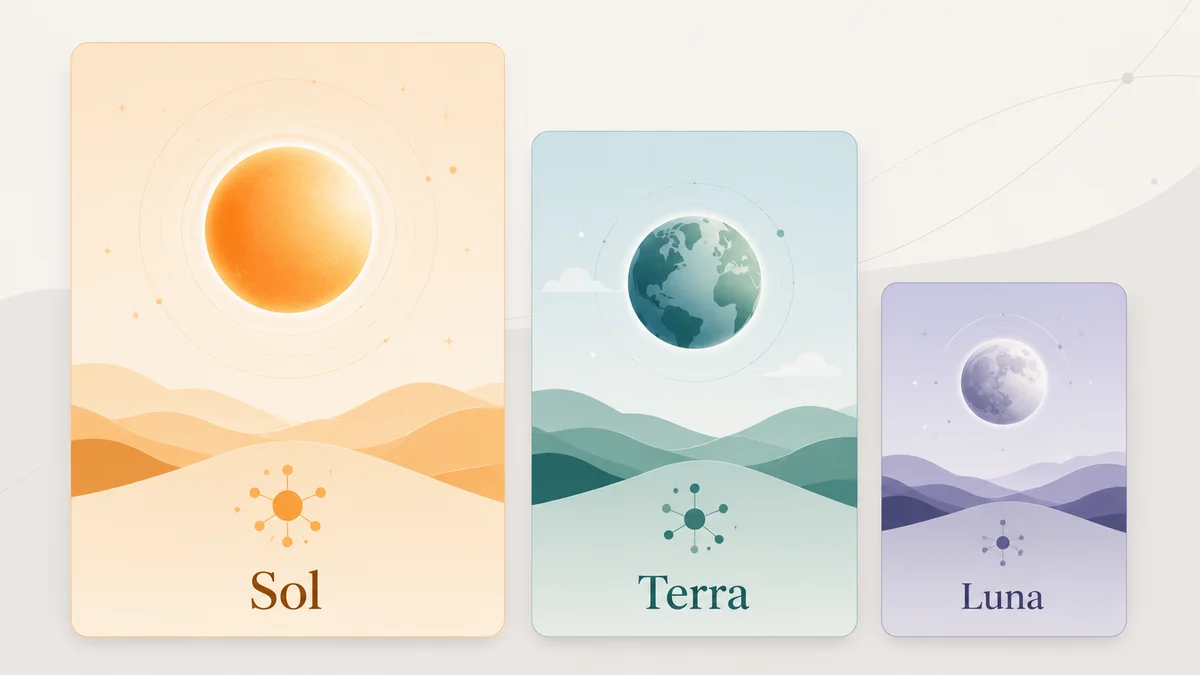
GPT-5.6 comes in three sizes. Sol is the flagship. Terra is the everyday workhorse, priced lower but performing close to the old GPT-5.5. Luna is the fastest and cheapest.
The naming is the interesting bit. The number (5.6) is the generation. Sol, Terra and Luna are durable tiers that can improve on their own timeline. So "Terra" a year from now might be far stronger than today's Terra, at the same slot in the lineup. If you build on the API, you pick a tier for the job instead of chasing a new model string every few months.
Pricing per million tokens: Sol is $5 in and $30 out, Terra is $2.50 in and $15 out, Luna is $1 in and $6 out.
The real story is cost per result, not raw score
Benchmarks always climb. The number worth watching this time is what you pay to get a job done.
On Agents' Last Exam, a test of long-running professional work across 55 fields, Sol sets a new high of 53.6. OpenAI says even at medium reasoning it beats Claude Fable 5 by 11.4 points at roughly a quarter of the estimated cost. On the Artificial Analysis Coding Agent Index, Sol scores 80 while using less than half the output tokens, finishing in less than half the time, and costing about a third less than the model it edges out.
Why that matters if you run a business: the cost of an AI feature is output tokens times price times how many times you run it. A model that reaches the same answer with fewer tokens is a smaller bill at the end of the month, not a bragging point. Cheaper per result is what lets you put AI in a product and still make the maths work. If you want the ground rules for getting good output in the first place, we wrote them up in how to prompt Claude and ChatGPT: the real rules that work.
Two new dials: max and ultra
GPT-5.6 adds two ways to spend more compute when a task earns it.
max gives the model more time to reason, check its own work, and revise. ultra goes further and runs four agents in parallel by default, splitting the work across them and pulling the results back together. You trade tokens for a stronger answer and a faster finish on hard problems. In the API, developers can build the same multi-agent behaviour through a beta in the Responses API.
This is the same direction the whole field is moving. If "agents" is still a fuzzy word, AI agents vs chatbots breaks down what the term actually means for a business.
It got noticeably better at design and computer use
Two gains stand out for anyone building products.
First, design judgment. With only high-level direction, GPT-5.6 produces interfaces that are genuinely usable, and its stronger computer-use lets it inspect the rendered result and fix visual problems, not just spit out code and walk away. On OSWorld 2.0, a test of driving real software, Sol hits 62.6% and beats Claude Opus 4.8 while using 85% fewer output tokens.
Second, artifacts. GPT-5.6 is better at turning messy inputs from Slack, Notion, Microsoft 365 and Google Drive into finished decks, documents and spreadsheets. It can read a reference deck's design system, layouts, fonts, spacing, colours, and apply it to new content. For anyone who rebuilds the same report every month, that is real time back.
Stronger on security, both ways
GPT-5.6 is OpenAI's strongest cybersecurity model so far. On ExploitBench it scores 73.5% against GPT-5.5's 47.9%. On SEC-Bench Pro it hits 71.2% versus 45.8%.
That cuts both ways, and OpenAI says so plainly. The same skill that helps a defender find and patch a hole helps an attacker exploit it. OpenAI's answer is to gate the most sensitive cyber capability behind verified access and a reasoning monitor that reads the conversation for intent, rather than blocking on keywords alone. For most businesses the takeaway is simple: the tools your security team can use just got sharper, and so did the tools aimed at you. If your team handles security work, this is worth a proper look.
What to do with this
You do not need to switch anything today. A few moves are worth making.
If you already use the OpenAI API in a product, test Terra and Luna against your current model on your own tasks. OpenAI's own framing is that many jobs running on the old GPT-5.5 do just as well on Terra at lower cost. That is a line-item saving you can measure in a day.
If you build or refine AI features, the multi-agent and programmatic tool-calling changes are the ones to read closely, because they change how much a complex task costs to run, not just how well it scores.
And if AI has been on your "we should look into this" list without moving, this release lowers the bar. Cheaper per result plus better design output means smaller, cleaner projects that pay for themselves. That is the kind of build we take on at dsrpt for clients across Australia and the GCC. If you have a use case in mind and want a straight answer on whether it is worth doing, talk to us.