

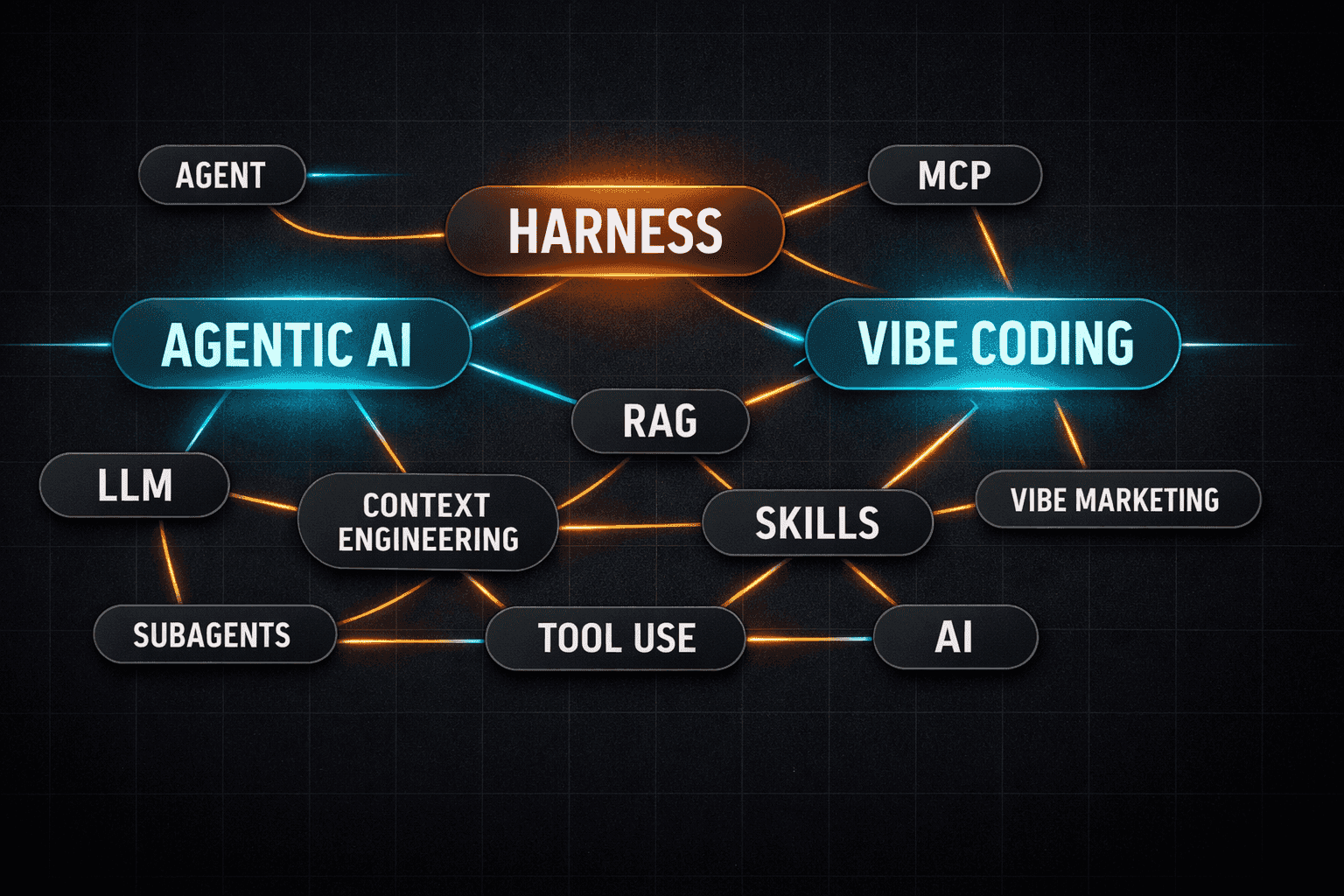
Someone asked me last week what "agentic AI" means. Before I could answer, they added: "and is it different from an AI agent? Or AI? Or a harness?"
Fair question. The terminology has exploded — half of it is genuinely new, the other half is the same thing renamed by whoever wrote the loudest blog post that month. If you're running a business in 2026, you don't need to care about all of it. You need to care about the 13 terms that change what you actually buy, build, or hire for.
Here's the glossary I wish someone had handed me two years ago.
1. AI — the word that means nothing now
What it actually means: Any software that uses machine learning. Which now means almost everything.
When someone says "we use AI," your first question should always be "for what?" followed by "using which model?" The word "AI" has been stretched so thin that it shows up on toasters and to-do apps.
I stopped using "AI" as a standalone word in client proposals about a year ago. It's too vague to price, scope, or promise against. Instead I write things like "Claude-powered intake triage" or "OpenAI summarisation step." Be specific. The fluff gets priced higher and delivered worse.
Use it when: Talking to non-technical stakeholders who don't need detail. Avoid it when: Writing a statement of work, pitching a tool, or making a build decision.
2. LLM — the engine under the hood
What it actually means: Large Language Model. The actual AI model — Claude, GPT-5, Gemini, Llama — that generates text, reasons, and decides what to do next.
An LLM on its own does nothing useful for your business. It's a very smart text completer. To get work done, you wrap it in an app, a harness, or an agent. Think of the LLM as an engine and everything else as the car.
There's a deeper breakdown of how prompts shape LLM output if you want to go one level down.
Rule of thumb: Pick the model for the job. Claude for long reasoning and code. GPT for quick general tasks. Open-source models for data you can't send to a third party.
3. AI Agent — an LLM with hands
What it actually means: A program that uses an LLM to pick actions, call tools, and loop until a goal is done. An agent can read a file, search Google, update your CRM, send an email, or trigger a webhook — and it decides when to do each thing based on the task you gave it.
The difference between a chatbot and an agent: a chatbot answers. An agent does.
I built an intake agent for a client last quarter. It reads incoming form submissions, scores them against their ideal customer profile, looks up the company's website, drafts a tailored reply, and drops it in their inbox for approval. No human touches it until review. That's an agent. A dumb chatbot with the same prompts would just tell you what the reply could look like.
If you want more on the split between bots and agents, we unpacked it in AI Agents vs Chatbots — why 2026 is the year of autonomous AI.
4. Agentic AI — the umbrella term
What it actually means: The whole category of AI systems that plan, act, and correct themselves to hit a goal. An agent is one unit. Agentic AI is the design pattern.
When a vendor says they have "agentic capabilities," what they usually mean is: the AI can take more than one step, use more than one tool, and recover when something breaks. That's it. Don't overthink it.
Red flag: If someone pitches you "agentic AI" but can't tell you which tools the agent has access to, what happens when a tool fails, and how approvals are handled — they don't have agentic AI. They have a chatbot with better branding.
5. Harness — where agents actually live
What it actually means: The runtime that wraps the LLM and gives it a working environment — files, terminal, browser, tools, memory, and the loop logic that keeps it going until the job's done.
Claude Code is a harness. Cursor's agent mode is a harness. OpenAI's Codex CLI is a harness. n8n with an AI node is a lightweight harness. A raw API call is not a harness — it's just a model call.
Harnesses are where the real power lives. The model is mostly the same everywhere. What changes your output is how the harness:
- → Gives the agent access to your filesystem or codebase
- → Lets it run and inspect commands
- → Handles tool failures and retries
- → Manages memory and context across steps
If you're picking AI tooling, pick the harness first, model second.
6. MCP — the USB-C for AI tools
What it actually means: Model Context Protocol. An open standard from Anthropic that lets AI models plug into external tools, data sources, and apps using one common interface.
Before MCP, every AI integration was bespoke. You wanted Claude to read your Notion? Custom code. Same agent needs to read Google Drive? More custom code. With MCP, any MCP-capable AI can use any MCP server — no rewrite.
For business owners, MCP means three things:
- Faster integrations. Connect your CRM, calendar, and drive once, use everywhere.
- Less lock-in. Swap Claude for another model, keep the integrations.
- More off-the-shelf. There are hundreds of MCP servers already — Slack, GitHub, Stripe, Postgres, Shopify.
We went deep on this in MCP servers — the protocol connecting AI to your business tools.
7. Skills — reusable AI recipes
What it actually means: A named, pre-packaged instruction set that tells an AI agent how to do a specific kind of task. A skill bundles a prompt, optional code, optional examples, and optional tool permissions into something you can invoke by name.
Claude Code ships with skills. So does Cursor. The pattern is spreading because it solves a real problem: nobody wants to paste the same 500-word prompt every time they write a blog post, do a code review, or run a GEO audit.
Think of a skill like a saved Photoshop action — but for language. You configure it once. You run it a hundred times. The output gets sharper because you refine the skill itself, not the prompt.
Where I use them: SEO audits, blog drafts, code review checklists, invoicing. Anything I do more than twice a month gets turned into a skill.
8. Subagents — agents that spawn agents
What it actually means: An agent that can delegate parts of a task to smaller, specialised agents running in parallel.
This is the "team of AIs" pattern. A main agent plans the work, then fires off subagents for independent chunks — one researches, one writes, one fact-checks, one handles images. They work simultaneously, return results, and the main agent stitches it together.
Why this matters: Subagents let you burn through big tasks that would choke a single agent's context window. It's the difference between a project manager trying to do everything themselves versus actually managing a team.
I use subagents for research-heavy tasks — scraping 10 competitor sites, drafting 10 variations of an ad, or running 10 independent code reviews. The clock time drops by 8x. Sometimes more.
9. Context Engineering — the new prompt engineering
What it actually means: The discipline of choosing, structuring, and injecting the right information into an LLM's context window so it can do the task. Prompt engineering is about how you ask. Context engineering is about what you put in front of the model — documents, examples, tool outputs, memory, code files, structured data.
Prompt engineering got you from "dumb answer" to "decent answer." Context engineering is what gets you from "decent answer" to "production-grade work."
The shift matters because for real business tasks — writing a proposal, reviewing a contract, debugging an app — the prompt is 5% of the problem. The other 95% is: does the model have the right context? The right documents? The latest data? The relevant examples?
More on this in prompt engineering vs context engineering.
10. RAG — giving AI your private knowledge
What it actually means: Retrieval-Augmented Generation. A pattern where, before the LLM answers, your system searches a private knowledge base (docs, manuals, past tickets, product catalogue) and pastes the relevant chunks into the prompt.
Without RAG, the model only knows what it was trained on — which is public internet up to a cutoff date. With RAG, it can answer questions about your specific business: "What's our refund policy?" "How did we handle a similar support ticket last year?" "Which products are in stock?"
RAG needs a vector database underneath. We covered the engine in Vector Databases Explained — the engine behind AI search and the business use case in Retrieval Augmented Generation (RAG) — the AI game-changer every business leader should know.
Use it for: Customer support bots, internal knowledge assistants, sales enablement, compliance Q&A.
11. Tool Use — how agents touch the real world
What it actually means: The mechanism by which an LLM calls an external function — a web search, a calculator, a database query, an API, a file read — and uses the result in its next step.
Tool use is what turns a chatbot into an agent. Without tool use, an LLM can only hallucinate answers from training data. With tool use, it can look things up, check prices, send emails, book calendars, run code.
When you're buying an "AI solution," the question to ask is: "What tools does the model have access to, and what happens when a tool errors?" If the answer is vague, the product is probably a chatbot in a trench coat.
12. Vibe Coding — building by describing
What it actually means: Writing software by describing what you want in natural language and letting an AI agent generate, run, and fix the code. You review and steer. The AI does the typing.
Andrej Karpathy coined the term in early 2025. It stuck because it named something real: a whole wave of solo builders and small teams shipping products without touching most of the code.
What it isn't: A replacement for understanding software. Vibe coding breaks the moment you hit a bug you can't describe, a security issue the AI glossed over, or a performance problem that needs actual engineering. The best vibe coders I know are strong engineers who've chosen to move up a level of abstraction. The worst are beginners who think the AI has their back — until it ships them a credential leak.
Where it shines: Prototypes, MVPs, internal tools, throwaway scripts, landing pages, simple CRUD apps. Where it breaks: Distributed systems, anything with real security requirements, performance-critical code, complex legacy codebases.
13. Vibe Marketing — one operator, whole funnel
What it actually means: Running the marketing function — research, strategy, copy, creative, ads, landing pages, email, analytics — with a stack of AI agents instead of a team of specialists. One person orchestrates what used to take six.
This is the natural next step after vibe coding. If you can build an MVP solo, why shouldn't you also run the campaign, write the copy, design the ads, and measure the results — with AI doing the grinding?
I run vibe-marketing playbooks for small clients now. A typical stack:
- → Claude for positioning research and copy drafts
- → An image model for creative variations
- → An agent that monitors ad performance and flags winners
- → An automation tool (n8n, Make, or Zapier) to glue it together
- → A human (me) who briefs, reviews, and kills bad ideas
The output quality is shockingly good when the operator is experienced. It's shockingly bad when it isn't. The bottleneck is judgment — knowing what to say, who to say it to, and when to stop the machine.
If you want the full read on how AI reshapes marketing workflows, how I use AI as a managing partner covers my current stack.
What to do now
You don't need to memorise this glossary. You need to be able to push back when someone uses these words loosely.
Three moves:
- When someone says "AI," ask "which model, for which task, with which tools?" If they can't answer, they're selling fog.
- When someone pitches "agentic AI," ask "what's the harness, and what tools does the agent have?" If they don't know what a harness is, walk.
- When someone pitches "vibe coding" or "vibe marketing" as a silver bullet, ask to see the output. The real thing is obvious. The fake version falls apart fast.
The terminology will keep shifting — another ten words will show up by the end of the year. What won't change is this: AI that does real work has a model, a harness, tools, and a human who knows what they want. If any of those four are missing, you're looking at a demo, not a product.
Want to see what a properly built agentic workflow looks like inside a real business? Book a chat with the DSRPT team and we'll walk you through one live.