
AI terms for founders: agents, RAG and MCP in plain English
The AI terms a founder actually needs, grouped by what they do, each with a small-business example. Plus the jargon you can safely ignore.
Abdulkader Safi 8 min read
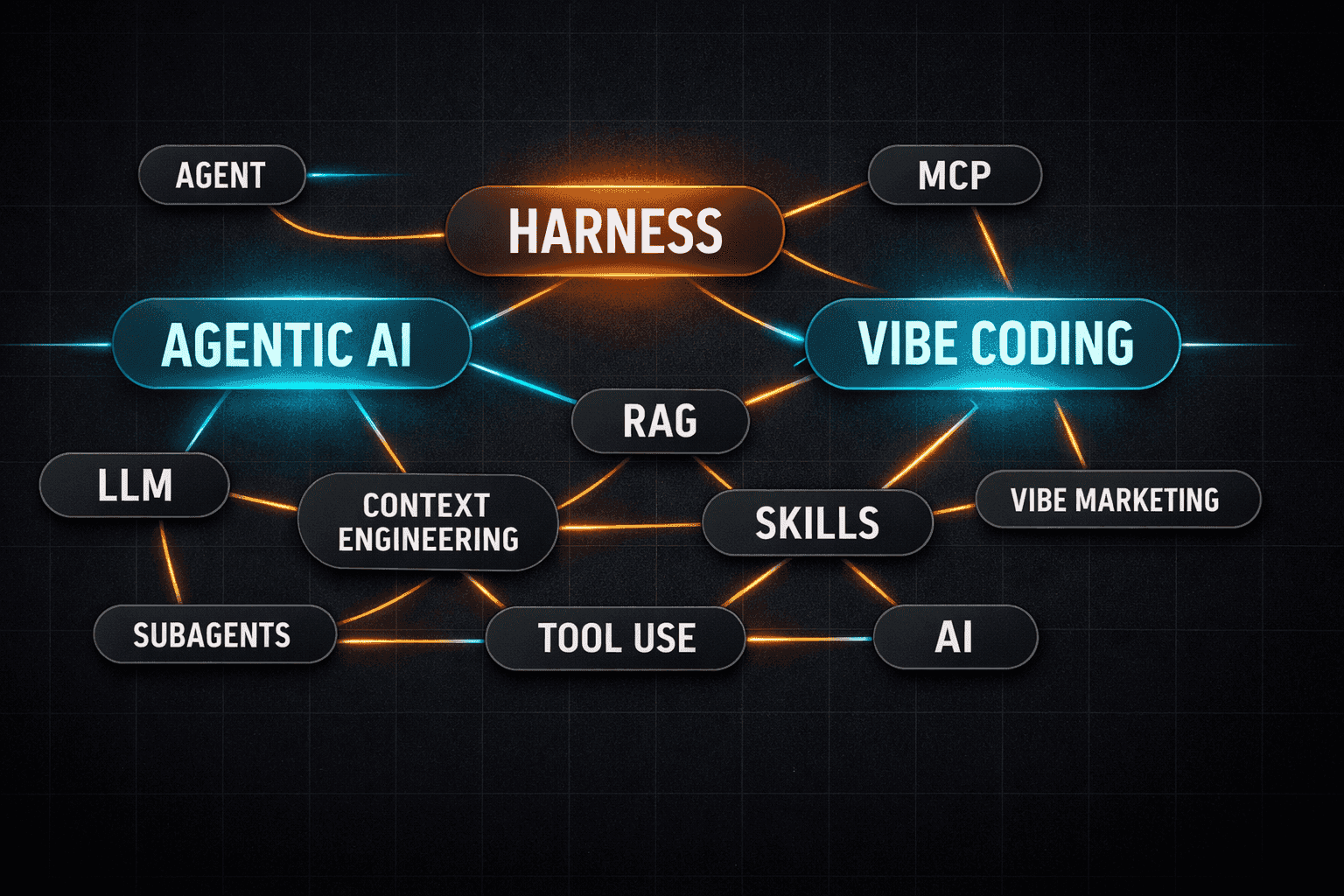
A founder needs about a dozen AI terms, and they answer three questions. What is the model, and how much can it hold at once? How does it learn about your business? What can it actually do on its own? Vibe coding sits to the side. Almost everything else you hear is marketing.
Earlier this year a founder asked me whether "agentic AI" was different from an AI agent. Or from AI. Or from a "harness", a word his developer had used in a meeting. Fair questions. Half the vocabulary is new, the other half is old ideas with fresh labels, and vendors mix both to sound expensive.
Below are the terms that change what you buy, build or hire, grouped by the job they do, each with an example from a real kind of small business. At the end: the ones you can skip.
The model itself: what it is and what it can hold
LLM (large language model)
The engine. Claude, GPT, Gemini and Llama are all LLMs. They're trained on huge amounts of text and predict the next word well enough to write, summarise, translate and reason through a problem.
On its own, an LLM can't open your inbox, check your stock or send anything. It needs software around it to do that (more on this below). So when a vendor says "we use AI", the useful follow-up is: which model, for which task?
Example: a furniture store in Salmiya uses a model to write product descriptions in English and Arabic. The model never touches the website. A staff member reviews the text and pastes it in.
Tokens
How models count text, and how you get billed. A token is a chunk of a word. In English, 100 tokens is roughly 75 words, which is the rule of thumb OpenAI gives. Arabic text usually takes more tokens per word, so the same message in Arabic costs more to process.
Every AI price list is per million tokens, with what you send in and what comes back priced separately. If a vendor quotes you a monthly AI cost, ask how many tokens they assumed per conversation. That one number drives the bill.
Context window
How much the model can read at once: your question, any documents you attached and the conversation so far. It's measured in tokens. Current models hold a few hundred thousand tokens, and some go up to a million.
Two things to know. Past the limit, older material gets dropped or the request fails. And even under the limit, answers get worse when the window is stuffed with things that don't matter.
Example: you paste a 300-page tender into a chat and ask about one clause. It might fit. You'll still get a sharper answer by giving it the relevant section only.
Hallucination
When the model states something false with full confidence. An invented refund policy, a citation that doesn't exist, a price you never set. It happens because the model predicts likely text. It doesn't check facts unless you give it something to check against.
You reduce it in two ways: hand it your real source material (see RAG below) and keep a person between the AI and anything a customer sees.
Example: a clinic chatbot that "knows" opening hours from its training will guess. One that reads the clinic's own hours page each time won't.
Teaching it about your business
Context engineering
Choosing what the model sees before it answers: which documents, which customer record, which rules, in what order. Prompt engineering is how you word the request. Context engineering is what you hand over with it, and in business work it matters far more. We covered the difference in prompt engineering vs context engineering.
Example: an AI drafting replies to quote requests needs your price list, your delivery areas and the customer's last order. Clever wording can't make up for a missing price list.
RAG (retrieval-augmented generation)
The AI searches your own documents first, then answers using what it found. Your files aren't baked into the model. They're looked up when the question is asked, so when you update a document, the answers update too. Most "chat with your documents" products are RAG underneath. The longer version is in our RAG explainer for business leaders.
Example: a property company loads its tenancy rules and maintenance procedures. A staff member asks "who pays for an AC repair in a furnished unit?" and gets the answer plus the clause it came from.
Getting it to do actual work
AI agent
An LLM that can take actions. It decides on a step, uses a tool, looks at the result and repeats until the job is done. A chatbot answers. An agent does things. We went deeper on this in AI agents vs chatbots.
"Agentic AI" is the same idea used as a label for a whole system. When a vendor says it, ask two things: what can the agent actually touch, and who approves what before it goes out?
Example: an intake agent reads each website enquiry, looks the company up in your CRM, scores the lead and drafts a reply. Someone on your team approves it before it sends.
Tool use
How an agent acts. The model asks to call a function, like searching the web, querying a database or creating an invoice. The software around it runs the call and passes the result back. No tools, no agent.
Ask any vendor for the list of tools their AI can call, and what happens when one of them fails. A vague answer to the second question tells you a lot.
MCP (Model Context Protocol)
A standard way to plug AI into your tools and data. Build an MCP connector for your system once, and any AI app that supports MCP can use it. Anthropic released it in late 2024 and in December 2025 handed it to the Agentic AI Foundation, a new body under the Linux Foundation backed by OpenAI, Google, Microsoft and AWS among others. Claude, ChatGPT, Gemini and Microsoft Copilot all support it.
For a business, that means less lock-in. I connect my own notes, calendar and Search Console data to Claude this way, and I could point a different AI app at the same connectors tomorrow. More in our MCP servers guide.
Harness
The software wrapped around a model that gives it hands: access to files, a terminal, a browser, memory, and the loop that keeps it working until the task is finished. Claude Code, Cursor and OpenAI's Codex are harnesses.
Two products running the same model can behave completely differently because of the harness. If you're choosing a coding or automation tool, compare harnesses first and models second.
Skills
Saved instructions for one repeated task, which the agent loads when that task comes up. Think of a recipe card: "write a blog post in our format", "prepare the monthly SEO report", "check a contract against our standard terms".
I write one for anything I'd otherwise explain twice. The first draft of this post came out of one.
Subagents
Helpers a main agent hands work to. Each gets its own task and its own context window, they can run at the same time, and the main agent combines what they bring back. They're useful for research across many sources, where a single agent would clog its own context window.
Example: checking 20 competitor websites for pricing. One subagent per site, one summary table at the end.
Building software with it
Vibe coding
Building software by describing what you want while the AI writes and runs the code, and judging the result by whether it works rather than by reading the code. Andrej Karpathy coined the term in a post on X on 2 February 2025, and Collins Dictionary made it its word of the year for 2025.
It's great for prototypes, internal tools and testing an idea over a weekend. It's risky for payments, customer data and anything that has to stay up at 3am.
Example: a founder vibe-codes a booking app prototype to show investors. Fine. Taking real KNET payments through it without an engineer reading the code is a different story (here's what accepting KNET properly involves).
AI terms you can ignore for now
- Agentic AI as its own category. It's agents. Ask what the agent can touch.
- Vibe marketing, meaning marketing run on AI tools and automations. Judge it by the output, same as any agency.
- "AI-powered" on a product page. It tells you nothing until you know which model, which task and which tools.
- Fine-tuning, which means retraining a model on your data. Most small businesses get further, faster and cheaper with RAG and good context.
What to do next
Next time someone pitches you AI, ask four questions. Which model? What can it see? What can it do? Who checks it before a customer sees the result? Any vendor worth paying answers all four in a minute.
If you want a second opinion on an AI proposal, or an agent built with the approvals in the right places, book a call with dsrpt.
Frequently asked questions
What AI terms do small business owners actually need to know?
About a dozen, and they answer three questions. What the model is and what it can hold at once (LLM, tokens, context window, hallucination). How it learns about your business (context engineering, RAG). What it can do on its own (AI agent, tool use, MCP, harness, skills, subagents). Add vibe coding if you plan to build software. Most other AI jargon is marketing.
What is the difference between AI and an AI agent?
AI is the broad label. An AI agent is a specific setup: a language model that can take actions through tools, check the result and keep going until a task is done. A chatbot answers your question. An agent can look up the customer, draft the reply and update the CRM. Most good agents still have a person approve anything that goes to a customer.
What does context window mean?
The context window is how much text a model can read at once: your question, any attached documents and the conversation so far. It is measured in tokens. Current models hold a few hundred thousand tokens, some up to a million. Going past the limit drops or rejects material, and stuffing it with irrelevant documents makes answers worse even when it fits.
What is RAG in plain English?
RAG, short for retrieval-augmented generation, means the AI searches your own documents before it answers and builds the answer from what it found. Your files are looked up when the question is asked, not baked into the model, so updating a document updates the answers. Most "chat with your documents" tools work this way.
Do I need to understand AI jargon to use AI tools in my business?
No. You can use ChatGPT or Claude well without any of it. The jargon matters when you buy or commission AI work, because vendors use it to sound more advanced than they are. Knowing what an agent, RAG and MCP actually are lets you ask what a product can see, what it can do and who checks its output.
Sources: